
Benefits of Using EV Stamping in the Automotive Industry
- Metal Stamping |
- Dec 16, 2025
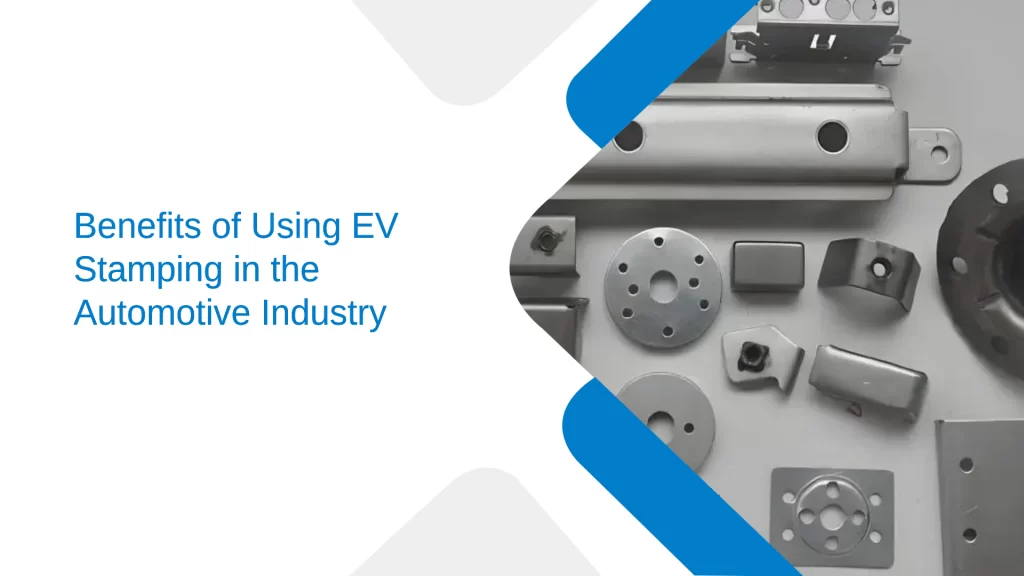
The challenge of the current global shift towards the production of electric vehicles has accelerated the pace of the modern automotive industry, necessitating the need to seek out more efficient and accurate manufacturing procedures on a global scale. Among these, EV Stamping has emerged as a cornerstone technology, enabling manufacturers to produce high-quality, lightweight, and durable components that meet uncompromising performance and sustainability standards.
At Eigen Engineering, EV stamping plays a key role in supporting the production of advanced electric vehicle architectures through precision, reliability, and process excellence.
EV Stamping in Automotive Manufacturing
EV Stamping refers to the metal forming process in which flat metal sheets are shaped into complex components using stamping presses and engineered dies. This process is especially critical for electric vehicle manufacturing, where dimensional accuracy, repeatability, and material efficiency directly impact vehicle performance, safety, and energy efficiency.
Through EV metal part stamping, manufacturers can achieve tight tolerances and consistent quality across large production volumes. The electrical stamping process enables the creation of components essential for battery systems, power distribution, structural assemblies, and thermal management, all of which are vital EV components.
Key EV Stamping Advantages for the Automotive Industry
The widespread adoption of EV Stamping is driven by a combination of technical and economic benefits that directly align with electric vehicle manufacturing goals.
1. Cost-Effective High-Volume Production
One of the most significant EV stamping advantages is its cost efficiency. As soon as there are tooling and dies which are being designed and tested, mass production at minimal incremental costs becomes possible through the stamping process. Durable dies are those that do not need a lot of maintenance, resulting in cost savings in the long run and consistency in production.
2. Material Efficiency and Reduced Waste
EV stamping is inherently material-efficient. In the process of minimising the scrap and minimising the scrap of raw materials, the process optimises the utilisation of the sheet metal. This efficiency would be particularly useful in the production of electric vehicles, which often use lightweight materials like aluminium and high-strength steel, because it helps in increasing the vehicle range and performance.
3. Automation and Precision
Modern electric stamping operations are highly automated, significantly reducing reliance on manual labour while improving consistency and precision. The use of automation can improve the quality of products by removing the variability that results from human error and make each stamped product to the precise specifications needed to be used in EVs.
4. Enhanced Strength and Durability
Stamping enhances the mechanical characteristics of metal by work hardening, which leads to better and stronger components. This is particularly critical for structural and safety-related EV components that must withstand mechanical stress, vibration, and impact throughout the vehicle’s lifecycle.
Precision and Quality Enhancement Through EV Stamping
Modern EV Stamping technologies deliver exceptional dimensional accuracy and surface quality. Control operations and high-quality dies used give uniformity between parts, which is essential to assemblies like battery enclosures, bus bars, electrical connectors and structural reinforcements.
And, also stamping causes work hardening on the metal sheet, which increases its strength and thus durability. This improvement in material properties is particularly valuable for safety-critical and load-bearing EV components, where reliability under stress is non-negotiable.
Efficient EV Stamping Processes Used in Automotive Applications
Eigen Engineering employs advanced electric stamping methodologies to address diverse design and production requirements:
- Progressive Die Stamping: Progressive die stamping is widely used in EV stamping due to its ability to perform multiple operations (cutting, bending, and forming) within a single continuous process. This method is ideal for high-volume production runs and ensures excellent repeatability, speed, and cost efficiency.
- Compound Die Stamping: In compound die stamping, multiple forming operations are completed in a single press stroke. This process is especially effective for flat or moderately complex EV components, offering reduced cycle times and consistent quality at a competitive cost.
- Multi-Slide and Transfer Stamping: For more intricate designs, multi-slide and transfer stamping processes provide enhanced flexibility. These methods allow greater control over complex bends and shapes, making them suitable for advanced electrical and structural EV components.
Each electrical stamping process is selected based on component geometry, material, and production volume to ensure optimal outcomes.
Applications of EV Stamping in Electric Vehicles
EV stamping is integral to the manufacturing of a wide range of electric vehicle components, ensuring accuracy and reliability across various systems. Common applications include:
- Battery trays and enclosures
- Bus bars and electrical connectors
- Brackets and mounting structures
- Floor panels and body-in-white components
- Heat shields and thermal protection parts
- Power supply and charging components
- Seating and interior structural elements
- Under-the-hood and transmission components
These applications demonstrate how EV metal part stamping supports both functional and structural requirements across electric vehicle platforms.
Quality, Speed, and Reduced Lead Times.
EV stamping significantly reduces production lead times due to fast setup cycles and rapid press operations. With tooling, manufacturers can respond quickly to design alterations or shifts in market demand. Such agility is necessary in a very competitive market of electric cars where speed-to-market and innovativeness are two of the main success factors.
Also, stamping provides high-quality surface finishes/dimensional control and eliminates or minimises the use of secondary machining processes. This also improves production efficiency and does not compromise on quality.
Global Supply Chain Compatibility
The electrical stamping process is globally standardised, making it easier to integrate stamped EV components into international supply chains. Most of the manufacturers and suppliers in the world have adopted the stamp specifications that are accepted globally, resulting in the standard quality and compatibility of the stamps worldwide, regardless of production sites.
This standardisation will allow the manufacturers of electric vehicles to produce on a large scale within the same quality standards.
EV Stamping Expertise at Eigen Engineering
At Eigen Engineering, EV Stamping is executed with a focus on precision, efficiency, and long-term value. Leveraging advanced tooling, automation-driven processes, and deep industry expertise, Eigen Engineering delivers reliable EV stamping solutions that align with the evolving requirements of electric vehicle manufacturers.
With a strong emphasis on progressive stamping capabilities, Eigen Engineering ensures high-quality outcomes across diverse EV components, supporting lightweight design, structural integrity, and electrical performance. The professional approach to the best technologies in manufacturing and the efficient engineering of its profession make this company achieve the best outcomes in all projects.
In Conclusion, as the automotive industry accelerates toward electrification, EV Stamping remains an essential manufacturing process that supports efficiency, sustainability, and performance. Through cost-effective production, material optimisation, automation, and superior quality, EV stamping enables manufacturers to meet the complex demands of modern electric vehicles.
With proven expertise and advanced stamping capabilities, Eigen Engineering stands as a trusted partner in delivering high-precision EV components that power the future of electric mobility.
About Author
Related Posts