

Electroplating vs Electroforming: What’s The Key Difference?
- Plating |
- Dec 29, 2025
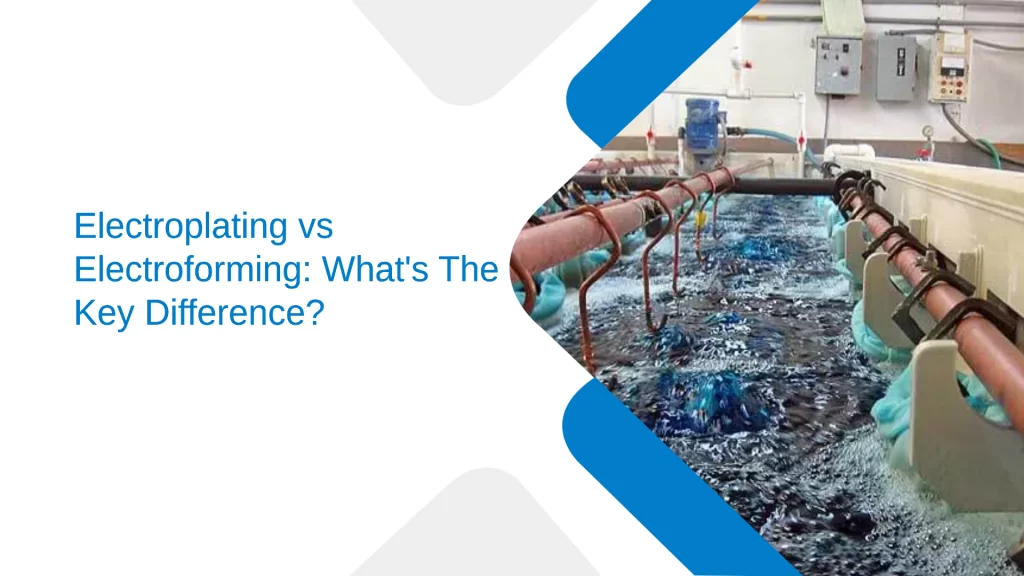
Surface treatment and metal deposition technologies dominating in the field of advanced manufacturing and precision engineering determine the quality and performance of products. Of them, on the analogy of analogy, one can often speak about the electroforming and electroplating since they are also similar in terms of relying on the electrodeposition process, but they have completely different aims. For OEMs and industrial manufacturers working with Eigen Engineering, understanding electroforming vs electroplating is critical for selecting the right process for accuracy, durability, and cost efficiency.
This article provides a clear, technical comparison of electroforming vs electroplating, highlighting process principles, material behaviour, applications, and strategic selection criteria.
Understanding Electroforming vs Electroplating
Electroforming as well as electroplating are based on the electrodeposition process, where metal ions are deposited on a conductive surface via the direct electrical current process. This is even though the basic purpose of these two approaches differs.
What Is Electroforming?
Electroforming is a fine metal forming where layer-wise metal is deposited on a conductive mandrel or mould. The metal deposited continues to increase in thickness to the extent of forming a self-wicking structure. After reaching the desired amount of thickness, the mandrel is stripped off, leaving a free-standing metallic part.
The electroless components are characterised to be very precise, intricate, and have even wall thickness. This renders the use of electroforming optimal for high-dimensional fidelity. Processes such as copper electroforming are particularly valued for producing components with excellent electrical conductivity and structural precision.
What Is Electroplating?
Electroplating is a metal coating process used on a pre-existing conductive object, whereby a thin layer of metal is applied onto the object to provide a coating. In contrast to electroforming, electroplating cannot be used to form a new component; rather, it improves the surface properties of a starting material.
The most frequently used purposes of electroplating are better corrosion resistance, wear resistance, electrical conductivity, and appearance. Copper electroplating, for instance, is frequently used to improve conductivity and provide a uniform base layer for additional coatings.
Process Comparison of Electroforming vs Electroplating
A deeper examination of the process stages highlights the technical distinction between electroforming and electroplating.
Preparation Stage
- The process of electroforming involves the formation of a mandrel within which the ultimate shape of the component is to be made. The mandrel can be conductive or non-conductive in nature, and a conductive coating can be put on it.
- Electroplating is a technique of cleaning and adhering to the surface of a pre-existing conducting entity to ensure that the plated material adheres properly.
Electrolyte Bath and Deposition
In both processes, an electrolyte solution that contains dissolved metal ions is used.
- The electroforming process entails deposition of metal ions onto the mandrel until the desired structural thickness is obtained.
- Electroplating involves a thin layer of metal ions over a base that has been covered. The thickness of the coating used is normally limited to microns.
Final Outcome
- Freestanding metallic structures produced by deep metallic load are known as electroformed parts.
- Components plated continue in their original shape, and the surface characteristics of the components are improved by the plated metal.
Key Differences Between Electroforming and Electroplating
The distinction between electroforming vs electroplating can be summarised across several critical parameters:
| Parameter | Electroforming | Electroplating |
| Primary Objective | Create new metal parts | Enhance surface properties |
| Metal Thickness | Microns to millimetres | Typically microns |
| Base Requirement | Mandrel (can be non-conductive) | Conductive substrate only |
| Design Complexity | Extremely high | Limited to existing geometry |
| Precision | Very high | Moderate to high |
This distinction forms the foundation of the electroforming vs electroplating decision for industrial applications.
Industrial Applications
There are important differences in industrially available technologies of electrodeposition depending upon functional, structural and performance needs. Understanding how electroforming vs electroplating is applied across industries enables engineers to select the most suitable process for precision manufacturing and surface enhancement.
Applications of Electroforming
Electroforming is commonly found in the industry with very high accuracy and repeatability requirements:
- Aerospace Engineering: Components and high-precision assemblies of utmost lightness and strength.
- Medical Equipment: Stents and philtres, as well as micro components made using electroforming with high tolerance requirements.
- Electronics and Microtechnology: Antennas, connectors, and microstructures produced using copper electroforming for superior conductivity.
Applications of Electroplating
Electroplating contributes to the industries that aim at durability, performance on and appearance on the surface:
- Automotive Industry: Colourful and rustproof coating on the parts.
- Jewellery Making: Fine sheets of precious metals at affordable luxury.
- Industrial Equipment: Coatings of the electroplated type against wear and against corrosion.
Material Considerations
Material selection plays a strategic role in electroforming vs electroplating decisions.
- Electroforming permits a large variety of materials, such as speciality metals. Copper electroforming is especially effective for applications requiring high conductivity and thermal performance.
- Electroplating gives attention to the compatibility of the surface material and the base metal. Copper electroplating is often used as a functional or intermediary layer to improve adhesion and conductivity.
Cost Analysis and Complexity Analysis
From a production and operational perspective, cost and complexity vary significantly against one another.
- Electroforming is more costly because of the production and required time to run the tests and to control and restrain the parameters.
- Electroplating is cheaper, quicker, and it can be used on a large-scale production where a thin coating is enough.
Selecting between electroforming and electroplating depends on balancing performance requirements against production efficiency.
Strategic Choice to Engineering Excellence
The decision of which option to use between electroforming and electroplating must be made based on the desired result:
- The option of electroforming is advisable when precision, complexity, and independence of structure are required.
- Select electroplating when the ultimate aim is on irregular product improvement, coverage, and cost sensitivity.
In certain high-technology production, the two processes can be used together, making the core with electroforming, then electroplating to improve the surface performance.
Conclusion
Although electroforming and electroplating both have a similar electrochemical foundation, these processes have opposite purposes in the manufacturing process. The comparison of electroforming vs electroplating reveals that one focuses on creating high-precision metal components, while the other enhances existing surfaces for improved performance and longevity.
A strong level of knowledge of these technologies at Eigen Engineering facilitates making well-informed decisions, designing processes that are better, and achieving high-end engineering results. Mastering the nuances of electroforming vs electroplating opens the door to innovative, high-performance metal solutions across industries.
About Author
Related Posts