
Precision Metal Forming: A Complete Engineering Guide
- Metal Stamping |
- Apr 3, 2026
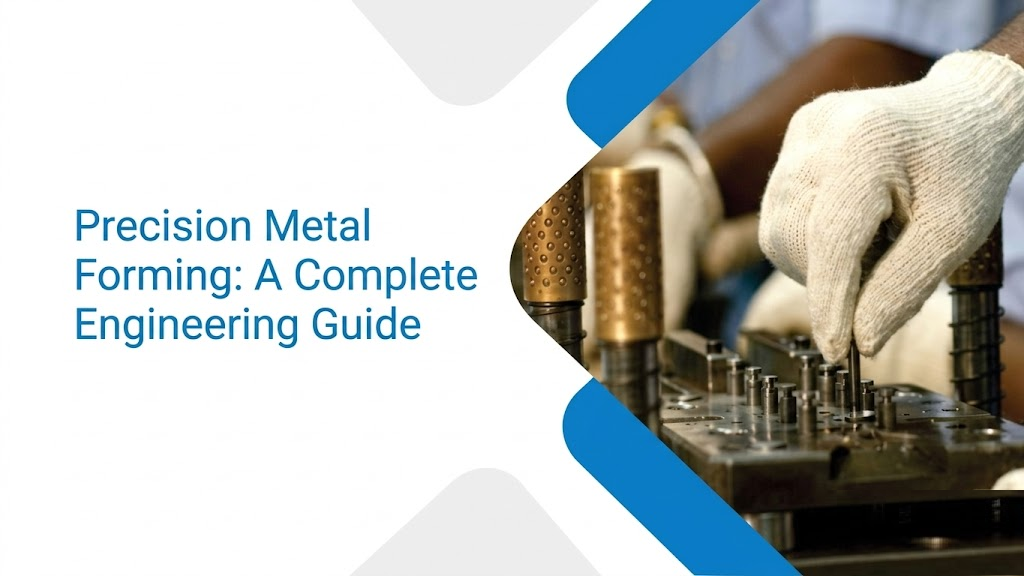
If you work in product design, procurement, or production engineering, you already know that getting a metal component to exact dimensional tolerances is not just about aesthetics. It is about function, safety, assembly fit, and long-term reliability. A component that is off by even 0.05 mm in the wrong direction can cause cascading failures in a larger assembly, and in sectors like aerospace or medical devices, that kind of deviation is simply not acceptable.
At Eigen Engineering, a TUV-certified manufacturer holding IATF 16949, AS 9100D, ISO 9001:2015, ISO 45001:2018, and ISO 14001:2015 certifications, precision forming is the core of what we do. Every component we produce goes through a documented engineering and quality process before it reaches your assembly line.
What Is Precision Metal Forming?
Precision metal forming is the controlled process of shaping metal stock, sheets, coils, or blanks, into finished components with tight dimensional tolerances, consistent geometry, and minimal material waste. The word ‘precision’ here is not marketing language. It means tolerances that are routinely held to ±0.01 mm to ±0.05 mm across an entire production run, whether you are producing 500 parts or 5 million.
General metal fabrication tolerates wider dimensional variation and is often acceptable for structural or non-critical components. Precision forming, by contrast, is the choice when components must fit precisely into assemblies, carry electrical current with consistent contact force, withstand cyclic fatigue loading, or pass the inspection requirements of aerospace, automotive, or medical supply chains.
Key Precision Metal Forming Techniques
Progressive Die Stamping
Progressive die stamping is widely used for the production of precision parts in very large quantities. You take a flat sheet of material and push it through multiple process steps within the same die set, performing a different function at each step blanking, piercing, bending, coining, etc., on the material as it progresses through each step until it is finished. This creates finished, complex parts at rates from 200 to 1,500 pieces per minute while holding tight tolerances over millions of pieces.
This process is ideal for electrical terminals, relay contacts, connector pins, automotive safety clips, and any component that requires complex geometry at scale. In-house progressive tooling, as Eigen operates, means faster engineering changes, lower tooling costs, and no dependency on external toolmakers.
Deep Drawing
Deep drawing transforms a flat blank into a seamless hollow shape, cups, shells, or cylindrical housings, by pressing the blank through a die with a punch. Because the process involves no welds or joints, deep-drawn components have excellent structural integrity and consistent wall thickness. Applications include sensor housings, battery caps, automotive enclosures, and consumer durable components.
CNC Press Brake Forming
CNC press brakes bend sheet metal along a straight axis with programmable precision. Modern machines include real-time angle measurement systems that compensate automatically for springback, the elastic recovery that causes bent metal to partially return toward its original position after the forming force is removed. The result is accurate, repeatable bend angles across entire production batches.
Fine Blanking and Coining
Fine blanking produces flat, burr-free components with smooth, square sheared edges and tolerances as tight as ±0.01 mm, often eliminating secondary finishing operations. Coining applies compressive stress through the full thickness of the material, suppressing springback and producing dimensionally stable components with excellent surface finish. Both processes are used in applications where standard blanking and bending cannot achieve the required quality.
Materials Used in Precision Metal Forming
Material selection directly determines what tolerances are achievable, what secondary processes are needed, and whether the finished component will perform reliably in service. The most commonly used materials in precision forming include:
- Stainless Steel (304/316), corrosion-resistant, work-hardens during forming; used in aerospace brackets, relay contacts, and medical-grade components.
- Cold Rolled Steel (CRCA), excellent formability and surface finish at lower cost; widely used in automotive stampings and switchgear parts.
- Aluminium Alloys, lightweight with good ductility; favoured in aerospace panels, electronics housings, and heat management components.
- Beryllium Copper, combines high electrical conductivity with spring properties; the material of choice for precision electrical contacts and connector pins.
- Phosphor Bronze, high fatigue strength in spring-tempered form; used for switch contacts, terminals, and precision springs.
- Titanium, exceptional strength-to-weight ratio and biocompatibility; used in aerospace fasteners and medical implant components.
Quality Systems and Certifications That Matter
For procurement teams evaluating precision forming suppliers, certifications are the most reliable proxy for underlying quality discipline. Here is what the key standards mean in practice for your supply chain:
- IATF 16949, the automotive quality management standard, requires PPAP documentation, statistical process control (SPC), measurement system analysis (MSA), and failure mode and effects analysis (FMEA).
- AS 9100D, adds aerospace-specific requirements for risk management, configuration control, first article inspection, and counterfeit part prevention on top of ISO 9001.
- ISO 9001:2015, the baseline quality management system standard, covers the complete cycle from customer requirements through manufacturing and delivery.
- ISO 45001:2018, occupational health and safety management; a systematic approach to workplace safety rather than reactive compliance.
- ISO 14001:2015, environmental management system; increasingly required by sustainability-conscious OEMs in Europe and North America.
Eigen Engineering holds all five certifications, validated by TUV. This is not a collection of plaques on a wall, it represents the process infrastructure required to supply aerospace primes, automotive Tier 1s, and electronics OEMs with consistent, traceable, documented quality.
Where Precision Metal Forming Creates Real Value
Precision forming is not industry-specific, it is a capability that serves any sector where dimensional accuracy and process repeatability matter. Eigen Engineering’s production experience spans:
- Aerospace and Defence, HV relays, connectors, cabin light sensor components, electromechanical relay parts, and aerospace battery components, produced under AS9100D with full material traceability.
- Automotive, window lift motor parts, door lock actuators, starter solenoid valve components, engine knock sensor housings, and safety system stampings are supplied under IATF 16949 PPAP.
- Electrical and Electronics, MCB contacts, relay springs, connector terminals, and switchgear contact bridges require consistent conductivity and spring force across high-volume production runs.
- Industrial and Consumer Durables, mobile charger contacts, sensor brackets, appliance terminals, and structural fasteners combine cost-efficient volume production with consistent quality.
Choosing the Right Precision Forming Partner
Not every supplier claiming precision capability can actually deliver it at production volumes. When evaluating a precision forming partner, the questions that matter most are straightforward: Do they design and build tooling in-house, or does it go out to a subcontractor? What press tonnage range do they operate, and does it match your component requirements? Can they demonstrate SPC data and process capability indices from comparable production runs? What secondary processes, plating, heat treatment, and assembly, can they offer under the same roof and the same quality system?
In-house toolroom capability is particularly important. When the toolmaker and the production engineer work in the same building, engineering changes that would take weeks with an external toolmaker can be implemented and validated in days. Eigen’s toolroom operates EDM, CNC milling, surface grinding, and CMM inspection, the complete toolmaking cycle without external dependency.
Bottom Line
Precision metal forming is a high-discipline manufacturing capability that rewards suppliers who invest in it seriously, in tooling, quality systems, process control, and engineering expertise. When you source precision-formed components from a supplier who truly has that capability, the benefits flow directly through your production: fewer quality escapes, fewer assembly line stoppages, less rework, and more reliable end products reaching your customers.
Eigen Engineering has spent over 20 years building and refining that capability, serving clients across three continents in some of the most demanding industries in manufacturing. Whether your project is at the design stage or moving into full production, our team is ready to support it.
About Author
Related Posts