
What Is a Copper Busbar and How Is It Used in Electrical Systems?
- Busbars |
- Jan 28, 2026
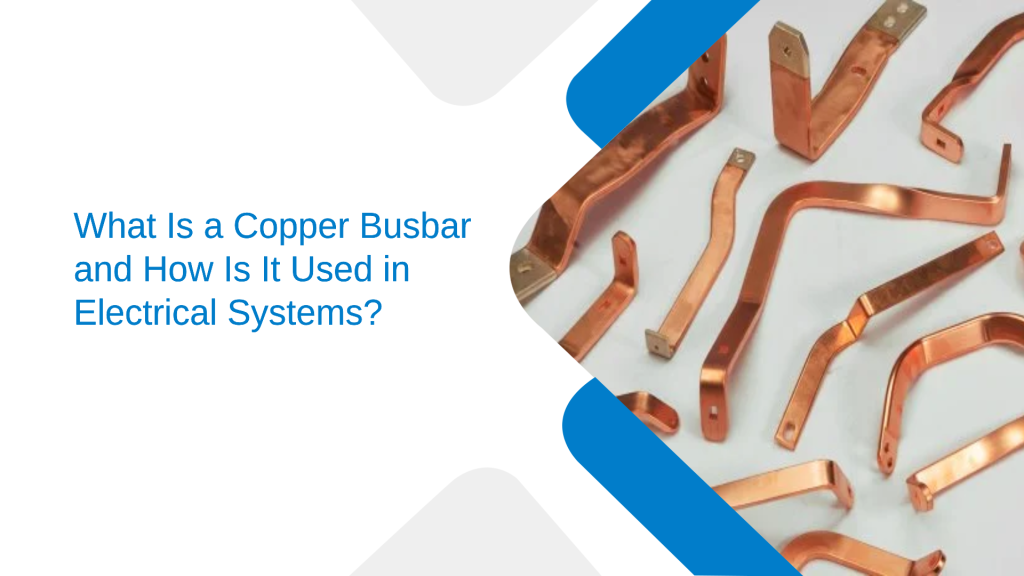
Today’s electrical systems require reliability, efficiency, and safety in power distribution. One of the most critical components that ensures a smooth and uninterrupted flow of electricity is the copper busbar. Widely used across industrial, commercial, and utility-scale installations, a copper busbar plays a central role in managing high-current electrical distribution with minimal losses.
At Eigen Engineering, precision-manufactured copper busbar solutions are engineered to meet demanding electrical and mechanical requirements, supporting advanced power distribution systems across industries.
What Is a Copper Busbar?
A copper busbar is a solid or laminated metallic conductor, typically flat or rectangular in shape, manufactured from high-purity copper. It is designed to share power in Outlet circuits through a single source of electrical power. Unlike conventional cables, a copper busbar offers a low-resistance path with a large surface area, which significantly reduces heat generation and energy loss.
Within electrical panels and switchboards, electrical bus bars act as central connection points for circuit breakers, isolators, switches, and metering devices. Copper guarantees the constant flow of current and increased safety as well as stability in the operation over a long period of time.
Why Copper Is the Preferred Material for Busbars?
Copper is still the choice of Electrical Busbar in the industry among other conductive materials. The large adoption of bus bars in important electrical systems is driven by the following material benefits:
- Outstanding Electrical Conductivity: Copper has one of the highest conductivity rates among metals used commercially, which reduces the losses of power and voltage drop.
- Thermal Efficiency: A copper busbar dissipates heat effectively, reducing overheating risks under high current loads.
- Mechanical Strength: copper has good structural integrity properties and can therefore resist mechanical stress, vibrations and thermal expansion.
- Resistance to corrosion: Copper is a substance that naturally does not corrode, allowing it to have a long service life even when utilised in strenuous industrial conditions.
These properties make copper busbars indispensable in applications where uninterrupted and safe power transmission is essential.
How Copper Busbars Are Manufactured?
The production of a copper busbar involves advanced metal forming and finishing processes to achieve precise dimensions and superior surface quality. Such common production methods as copper stamping, CNC machining, bending, drilling and surface plating are used. Manufacturing accuracy ensures clean edges, the correct positioning of holes, and uniform thickness is needed in manufacturing because all these are necessary to make good electrical connections.
To further enhance performance and durability, copper busbars may be coated with tin or silver. They consist of oxidation-resistant, conductive, and life cycle prolonging coating used in high-load electrical systems.
Function of a Copper Busbar in Electrical Systems
The primary function of a copper busbar is to collect electrical power from an incoming supply and distribute it safely and efficiently to multiple circuits. It plays the role of an electric hub, simplifying the structure and safety of operation of the system.
In comparison to cable-based systems, electrical bus bars provide:
- Uniform power distribution
- Reduced wiring complexity
- Easier system expansion
- Better accessibility to inspection as well as maintenance.
These characteristics make copper busbar systems indispensable in modern power infrastructure.
Types of Copper Busbars Used in Electrical Systems
Copper busbars are available in multiple configurations to suit different electrical and mechanical requirements.
By Shape and Structure
- Flat Copper Busbar: The most widely used type, offering excellent heat dissipation and easy installation.
- Rectangular Busbar: Suitable for high-current applications and compact panel layouts.
- Round or Tubular Busbar: Used where mechanical flexibility and cooling efficiency are priorities.
- Flexible or Laminated Busbar: Composed of multiple thin copper layers, ideal for vibration-prone environments and tight spaces.
By System Design
- Single Busbar System: Cost-effective and commonly used in small electrical panels.
- Double Busbar System: Provides redundancy and operational flexibility for larger installations.
- Ring Busbar System: Ensures high reliability and reduced outage risks in substations.
- Main and Transfer Busbar System: Enables uninterrupted power supply during maintenance or load transfer.
The configurations are a safe and structured distribution of power as per the application requirements.
Manufacturing and Surface Treatment
At Eigen Engineering, copper busbar components are produced using advanced metal forming techniques such as precision stamping, bending, and CNC machining. Using the processes, dimensional accuracy, smooth edges and consistent performance are ensured.
Bus bars copper can be treated with surface-coated with:
- Tin plating
- Silver plating
- Nickel coating
These finishes protect the copper busbar from oxidation and improve electrical contact quality.
Insulation and Safety Considerations
Safety is a critical aspect of electrical bus bars. Copper busbars are often insulated to prevent accidental contact, short circuits, and system faults. Widespread techniques of insulation are PVC coating, insulation with the use of epoxy resin, heat-shrink sleeves, and insulation with air-filled enclosures.
Insulated copper busbar systems enhance operational safety, reduce maintenance risks, and ensure compliance with electrical safety standards in industrial and commercial installations.
Applications of Copper Busbars in Electrical Systems
The versatility of copper busbars allows their use across a wide range of sectors:
- Industrial Facilities: Driving of heavy machines, motors, as well as machines that manufacture.
- Commercial Buildings: Control of lighting, air conditioning, elevator and emergency power.
- Power Plants and Substations: The task of high-current transmission and high load switching.
- Renewable Energy Systems: Used in wind power systems, battery storage systems, and solar inverters.
- Data Centres: This is a measure that maintains efficient and constant power supply to servers and cooling systems.
In all these applications, copper busbars deliver reliable performance, compact design, and long-term efficiency.
Advantages of Using Copper Busbars
Replacing traditional cables with a copper busbar system offers several operational benefits:
- Small Size and Manages Space: Minimises the amount of clutter and wastage of space in panels.
- Large current-carrying Capacity: Can carry large electric loads, and will not overheat.
- Low Renewal Needs: No obscurities in connections, easy to examine and service.
- Better Reliability of the System: Reduces hot spots and loose contacts/connections, and power variations.
- Scalability: Says it can easily increase the circuit to increase loads.
These advantages explain why electrical bus bars are increasingly preferred in modern power distribution designs.
Conclusion
A copper busbar is far more than a simple conductor; it is a foundational element that ensures efficient, safe, and organised electrical power distribution. With superior conductivity, mechanical strength, and adaptability, copper busbars play a vital role in industrial, commercial, and utility-scale electrical systems. They have a great boost in performance of the system when properly designed and produced, minimising losses of energy as well as minimising the risks to the safety of the system.
About Author
Related Posts