
What Is Metal Stamping in the Automotive Industry?
- Automotive & Ancillary |
- Mar 26, 2026
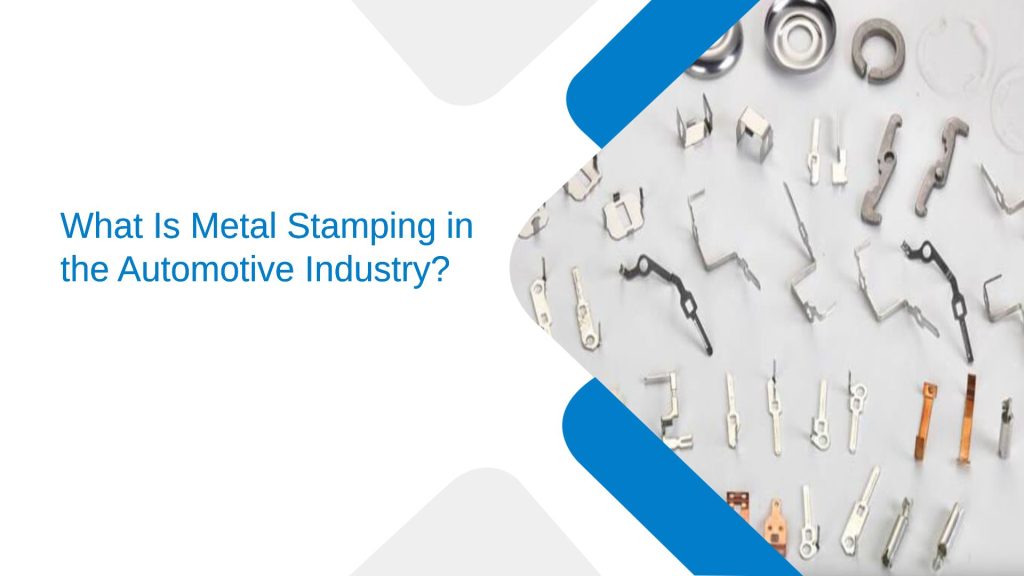
Automotive metal stamping is one of the basic processes in the context of the contemporary car industry manufacturing, where the mass production of high-precision parts is made possible. Structural frameworks to complicated body panels, this production method means that all the components of the vehicle are of high quality in terms of durability and safety, as well as in terms of dimensional accuracy. Automotive metal stamping has remained an essential part of its manufacturing process as car manufacturers keep on relying on it to attain quality and scale in their production.
Understanding Automotive Metal Stamping
Automotive metal stamping is the production technology of the metal stamping of flat metal sheets (usually of steel, aluminium or alloys) under high-pressure stamping presses, under shaped dies. The method is popularly applied to produce parts where consistency and strength are needed, along with dimensional accuracy.
The method favours mass production, where a manufacturer can produce thousands of the same parts with almost no deviation. As a result, metal stamping for the automotive industry ensures both cost efficiency and product reliability, two critical requirements in automotive manufacturing.
Automotive Metal Stamping Process
The automotive metal stamping process involves a sequence of carefully controlled steps, each contributing to the final component’s geometry and functionality. Though they vary based on the part complexity, the process does not exclude the following steps:
- Blanking: This is the first step where flat sheet metals are cut into pre-set shapes, also referred to as blanks. These are the inception of operations for further forming.
- Forming and Bending: The blanks are then formed with the help of die pressures that modify the metal to bend or form it to the required shape. This is an important measure towards characterising the structural integrity of the component.
- Punching and Piercing: Punching operations are used to introduce holes, slots and other features to the part so that it would fit in an assembly.
- Trimming: Any unnecessary matter is cut off to result in the accurate dimensions and slick sides to achieve a higher level of utilisation and appearance.
- Finishing and Inspection: Finishing components can be coated or polished, and then they are subjected to stringent quality inspection to ascertain that the automotive standards are met.
This structured automotive metal stamping process allows manufacturers to produce intricate parts efficiently while maintaining tight tolerances.
Applications of Automotive Stamping
A great variety of components of vehicles are manufactured by stamping, such as:
- Doors, hoods, and fender body panels.
- Parts of the construction, such as the frame of a chassis and reinforcing elements.
- Part engine and transmission parts.
- Those are brackets, mounts and supports.
- Components that are safety critical, such as parts of seat belts and crash structures.
The versatility of metal stamping for the automotive industries allows manufacturers to produce both large and small components with equal precision.
Advantages of Automotive Metal Stamping
There are quite a number of reasons why automotive metal stamping should be widely adopted:
- High Production Efficiency: With this, the process is highly automated, and thus, it can produce high volumes of components quickly without failure in quality.
- Precision and Consistency: In automotive metal stamping, a batch-to-batch consistency is guaranteed, and that is necessary to ensure the safety and performance level of every vehicle.
- Cost-Effectiveness: By minimising material waste and reducing manual labour, the automotive metal stamping process offers significant cost savings, particularly in high-volume production.
- Material Versatility: There is also a wide variety of metals, such as high-strength steel and lightweight aluminium, that can be utilised to achieve various design and performance requirements.
- Improved Resilience and Performance: Stamped metal retains its structure, which can be used in the destructive environments of the automobile.
Role in Modern Automotive Manufacturing
The modern-day competitive automotive industry is putting manufacturers under consistent stress to ensure they are efficient, cost-effective and also compliant with the standards of safety and environmental issues as they keep changing. Automotive metal stamping facilitates the achievement of these goals because it facilitates the making of lightweight but strong parts that help in creating more fuel-efficient and less emitting cars.
Further, the development of automation, robotics, and die design offers more possibilities to automotive stamping, as the complexity of the design and high-speed production can be performed. This is necessary not just for traditional cars, but also for electric and hybrid cars.
Why Choose Eigen Engineering?
Eigen Engineering is the company when it comes to automotive metal stamping solutions because it believes in the use of high-tech software, company experience, and fidelity to quality. The company has a very keen concern for precision manufacturing, and thus, they provide components that are of the utmost automotive standards.
Equipped with modern infrastructure and experienced professionals, Eigen Engineering ensures seamless execution of the automotive metal stamping process, from design and prototyping to large-scale production. Quality control is the focus of the company, and all of the batches are consistent and reliable.
Besides, Eigen Engineering provides automotive stamping that is based on a particular client’s needs, which facilitates flexibility in the various automotive needs. They find application in the automotive industries to stamp metals in complicated designs and bulk orders, which makes them a favourite in the automotive industries.
Conclusion
Automotive metal stamping is an important manufacturing process that supports the creation of present-day automobiles. This guarantees efficiency, consistency and scalability by making precise and durable parts out of flat metal sheets, used in the manufacture of automobiles. The structured automotive metal stamping process, combined with its cost-effectiveness and versatility, makes it an indispensable solution for producing high-quality parts.
In the case of organisations such as Eigen Engineering, the available solutions are the high-quality automotive stamping systems that can assist organisations in providing high-quality and accurately manufactured parts in line with the dynamic requirements of the automotive sector.
About Author
Related Posts