
Tool and Die Making Explained: Processes, Tools, and Applications
- Progressive Tooling |
- Jan 23, 2026
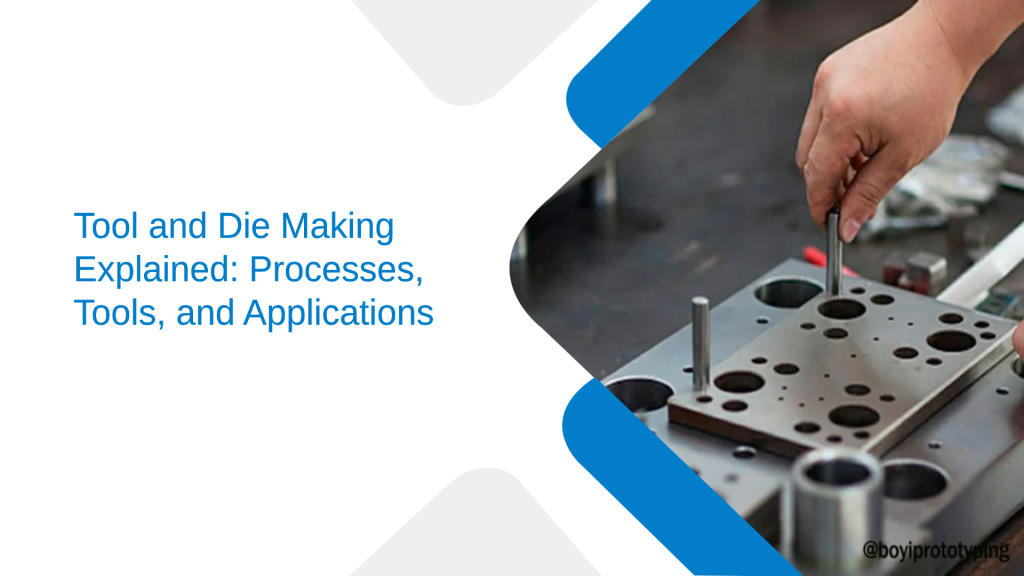
In modern manufacturing, tool and die engineering forms the backbone of mass production, precision, and consistency. From automotive body panels to consumer appliances and industrial components, the tool and die process enables manufacturers to produce identical parts at scale with exceptional accuracy. At Eigen Engineering, advanced tool and die capabilities are integrated with engineering expertise to deliver reliable, high-performance tooling solutions for diverse industries.
Understanding Tool and Die Manufacturing
Tool and die making is the specialised practice of designing and fabricating tools, dies, jigs, and fixtures used to manufacture components with exact dimensions and repeatable accuracy. In industrial settings, tool and die systems are essential for mass production, as they ensure that every component produced matches predefined specifications.
Though the terms are commonly used interchangeably, there is a distinction which is pretty evident. Any mechanical tool that is used to cut, shape, support or form material is known as a tool, but a die is a particular form of tool that requires the material to be forced into a mould. In practice, a tool die works as part of an integrated system, combining cutting, forming, and guiding elements within a press or moulding machine.
Historical Evolution of Tool and Die
The development of modern tool and die practices can be traced to the introduction of interchangeable parts during the Industrial Revolution. Initial production had been highly dependent upon manual labour, though standardised tooling allowed goods to be produced consistently without a great deal of re-fitting or re-adjustment. Over time, the advancement of power presses, CNC machines, and precision measurement systems transformed tool and die shops into highly specialised engineering environments.
The modern world now has companies like Eigen Engineering, which are functioning with an advanced tool room that specialises in complex press tools, progressive dies and precision fixtures to prepare to achieve the modern demands of the manufacturing world.
Tool and Die Manufacturing Process
The tool and die manufacturing process involves a structured sequence of design, fabrication, assembly, and validation. The importance of every stage lies in its precision, reliability and effectiveness.
- Design and Engineering: It starts with the detailed design depending on the geometry of the components, type of material used in production, volume of production and the requirement of tolerance. Calculations for force, shut height, die thickness, and scrap management are performed to create an efficient process die layout.
- Material Choice: Tool steels and alloys are high-grade to be able to survive recurrent mechanical loads. Selecting the correct material directly has an influence on the life of the tools and also the dimensional stability.
- Machining and Fabrication: Fabrication of individual components is achieved by the use of precision machining techniques that include CNC milling, turning, grinding and EDM. These include punches, die blocks, plates, and guide elements, all of which form the core of the tool die assembly.
- Assembly and Alignment: Components are put together with precise correct alignment with guideposts, dowel pins and bushings. Adequate tracking guarantees uniform operation and reduces the levels of wear.
- Testing and Validation: Trial runs Testing: Trial running is performed to verify the quality of the output, dimensional accuracy, and production efficiency. Before final deployment, adjustment is done.
Key Components in Tool and Die Systems
A standard tool and die assembly comprises multiple functional elements, each playing a critical role:
- Punch and die block: The elements of core forming and cutting.
- Punch Holder and Die Holder: Structural organisms which support the assembly.
- Stripper Plate: This takes away the material that has been used in the punch following operation.
- Guideposts and Bushings: keep the operations of the press cycles in correct positioning.
- Shank and Ram Interface: Connects the tool die to the press machine.
The accurate integration of these elements is essential for efficient process die operations.
Types of Tool and Die Operations
Different tool and die constructions enable a wide range of manufacturing operations, including:
- Blanking and piercing
- Bending and forming
- Drawing and deep drawing
- Embossing, coining and trimming.
Based on application requirements, common tool and die classifications include simple tools, compound tools, progressive tools, transfer tools, bending tools, and drawing tools. Progressive tool and die systems are especially valued for high-volume production due to their ability to perform multiple operations in a single continuous cycle.
Essential Tools Used in Tool and Die Making
Professional tool rooms are based on highly precise and repeatable tool, the professional tool rooms, which make use of sophisticated die maker tools. Common tools include:
- Complex geometry CNC machining centres.
- EDM wire and sinker machineries of complex profiles.
- Surface and cylindrical fine tolerance grinders.
- Accuracy checking tools of inspection and quality checks.
These die making equipment allows complex dies to be produced, which will meet the highest standards in the industry.
Types of Dies and Press Tools
Varied manufacturing specification requires varied die constructions. Common types of Dies include:
- Simple Dies – Cutting is done in one stroke.
- Compound Dies – Cut more than once per stroke.
- Progressive Die – The sequential operation in various stations can be provided in every single press stroke, which is very productive.
- Transfer Dies – Transfers confined pre-cut blanks between stations of complex parts.
Each process die is designed to optimise material usage, cycle time, and product consistency.
Read Also: Understanding the Difference Between Tooling and Die
Applications of Tool and Die Manufacturing
The applications of tool and die systems span numerous industries. Components manufactured by these techniques are part of:
Metal Stamping & Pressing: Used for mass production of high-precision metal parts such as body panels and brackets.
Die Casting: Produces complex, thin-walled components from aluminium, zinc, or magnesium with high dimensional accuracy.
Injection Molding: Enables efficient manufacturing of plastic components for consumer, industrial, and medical use.
Forging & Forming: Creates high-strength metal parts for heavy machinery and structural applications.
Industrial Tooling: Supports accurate holding, cutting, and shaping of materials across manufacturing processes.
Industry Specific Applications:
Automotive Applications: Supports production of engine components, transmission housings, and body panels.
Electronics Applications: Used for manufacturing smartphone frames and laptop casings with tight tolerances.
Medical Applications: Produces precision components required for reliable healthcare and diagnostic devices.
High-volume production, dimensional accuracy, and repeatability make tool and die manufacturing indispensable in these sectors.
Why Precision Matters in Tool and Die Manufacturing?
The success of any tool and die project depends on precision engineering. Ineffectively designed tools result in wastage of materials, down-time and erratic parts. Conversely, expertly engineered tool die systems optimise material utilisation, reduce cycle times, and ensure uniform output, key advantages in competitive manufacturing environments.
Eigen Engineering’s Tool and Die Expertise
At Eigen Engineering, tool and die manufacturing is driven by innovation, experience, and advanced infrastructure. With an in-house tool room and skilled engineers, Eigen delivers customised process die solutions aligned with client-specific production needs. From concept to commissioning, every tool and die project is engineered to maximise efficiency, durability, and value.
Conclusion
Tool and die manufacturing remains indispensable to modern industrial production. By combining precision design, robust die maker tools, and optimised process die methodologies, manufacturers can achieve high-volume output without compromising quality. With its comprehensive capabilities, Eigen Engineering stands as a trusted partner for advanced tool and die solutions that power today’s manufacturing excellence.
About Author
Related Posts