
What Is Electrical Stamping? Process, Materials, and Applications
- Metal Stamping |
- Dec 23, 2025
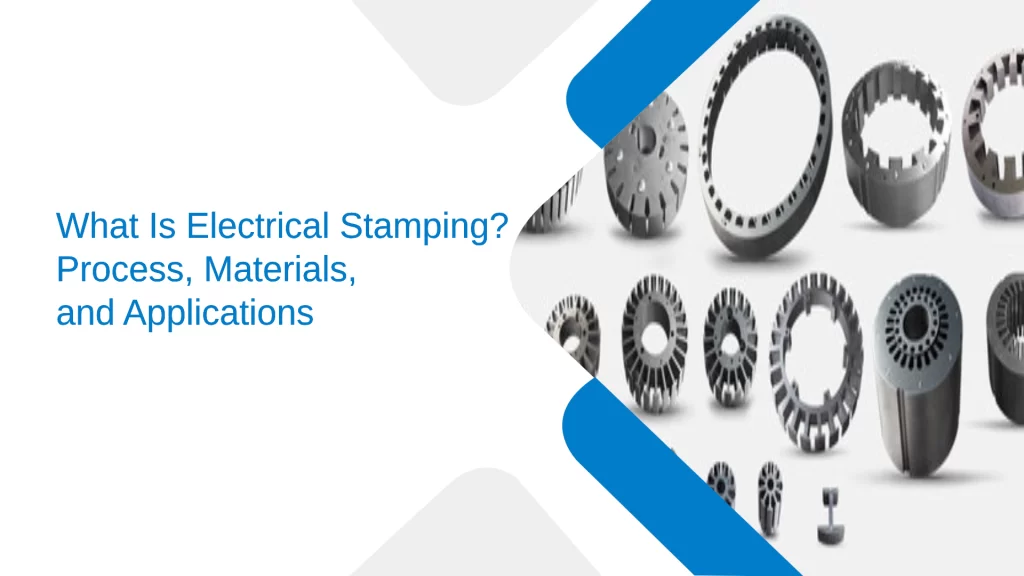
Electrical stamping, also referred to as lamination stamping, is a specialized manufacturing method for creating laminated electrical components from a base metal. The laminations serve as the magnetic support structure for many types of electrical devices, including electric motors, transformers, and generator alternators. Electric stamping relies on the careful selection of electrical steel grades and the use of precision stamping techniques to enhance the performance and energy efficiency of electrical devices while reducing their energy losses.
Based on the requirement for energy-efficient appliances, the use of automation in industrial processes, and the increasing number of electric vehicles being produced, electrical stamping will continue to play an important role in the provision of consistent and reliable electromagnetic performance from electrical devices.
Understanding Electrical Stamping
Essentially, electrical stamping is the process by which thin sheets of specially designed steel are cut into an exact shape using high-speed presses. After the shape is formed, stacking all of the stamped steel will then create the stator & rotor cores.
Additionally, electrical laminated cores are built using numerous layers of thin material that have insulation separating each layer. This layer construction also helps to reduce the amount of heat and energy lost due to eddy current loss that is typically seen in solid core designs.
Electrical stamping is commonly found in all types of electrically powered consumer goods as well as high power industrial and automotive applications, where the requirement for accuracy and repeatability in manufacturing is of the utmost importance.
Core Purpose and Function of Electrical Stamping
Lamination Stacking
Electrical devices rely on stacked laminations rather than a single solid metal block. Each lamination is electrically insulated from the next, which limits circulating eddy currents. This insulation improves efficiency, reduces heat buildup, and protects the motor or transformer from premature failure.
Improved Efficiency and Performance
Precision-cut laminations ensure uniform magnetic flux throughout the core. This uniformity improves torque output in motors, minimizes vibration and noise, and increases the operational efficiency of transformers and generators.
Materials Used in Electrical Stamping
Electrical stamping materials are very important because all the final performance characteristics of an electrical stamping depend on the types of materials used for them. Commonly, electrical stamping uses the following materials:
- Silicon Electrical Steel (E-Steel): Silicon E-Steel is a highly magnetic material with a low core-loss that makes it a good fit for electric motor and Transformer applications.
- CRNO (Cold Rolled Non-Oriented) Steel: CRNO Steel is commonly used for rotating equipment (e.g., electric motors, generators, etc.) since it has excellent magnetic properties in both directions at the time of manufacture.
- CRGO (Cold Rolled Grain-Oriented) Steel: CRGO Steel is primarily used in the manufacture of transformers due to its magnetic properties being in one direction (for magnetic flux to follow).
- CRCA (Cold Rolled Close Annealed) Steel: CRCA Steel is a cold-rolled, close-annealed steel that is used for some applications that require good surface finish and/or formability.
These materials are selected based on the required magnetic behavior, efficiency targets, and application environment.
Electrical Stamping Manufacturing Process
1. Design and Engineering
Using CAD, Engineers develop accurate Lamination profiles for the Stator and Rotor by modelling the Magnetic Flux Path and Mechanical Strength of the Assembly.
2. Punching and Blanking
Custom Die linked to a High-Speed Press punch thousands of Tomes of Chaplets out of Steel Plates, following strict dimensional tolerance to provide uniform performance.
3. Stacking and Insulation
The stamped Laminated material is packed in a Controlled Manner and coated or varnished to insulate between the laminated layers to assist with Electrical Conductivity.
4. Welding or Bonding
Advanced Welding or Bonding Techniques are utilized to attach the Lamination Stack, ensure Alignment & Mechanical Integrity of the stack while preserving the Magnetic Properties.
5. Final Assembly
The completed Lamination Stack is incorporated into the Component Motor, Generator or Transformer.
Types of Electrical Stamping Methods
- Progressive Die Stamping – In this process, a longitudinal metal strip continually feeds through multiple locations within a single die (semi-permanent tooling). Each location has been designed to perform a separate function, making this method suitable for producing high volumes of parts at the same level of quality.
- Compound Die Stamping – This process consists of multiple cuts completed with a single press stroke. This method is best when the part is very complex, or it is important that the shape remains consistent from one part to another.
- Notching – This operation is typically used for larger diameter laminations because progressive dies are not cost-effective for these applications. Notches are cut separately, thus they can be tailored to meet an application’s requirements in both volume and/or customization.
Key Specifications in Electrical Stampings
- Thickness: The thickness usually falls between 0.35 mm and 0.65 mm
- Diameter: Diameter can vary widely from approximately 50 mm for small appliances to over 300 mm for industrial motors.
- Surface Treatment: Corrosion protection and electrical insulation are achieved through surface treatments such as zinc coating, electroplating, or epoxy coating.
Each of these specifications has been developed based on the requirements of the specific application in terms of electrical, thermal, and mechanical performance.
Common Applications of Electrical Stamping
Home Appliances: Ceiling fans, washing machines, mixer grinders, air coolers, refrigerators, etc., require stamped electrical components because they must be able to run quietly and be efficient.
Industrial Equipment: Submersible pumps, compressors, monoblock pumps, power tools, etc., all use stamped laminations, which allow manufacturers to create durable and energy-efficient products.
Power Distribution: Many transformers and voltage regulators use laminated cores to reduce harmful energy losses and ensure that all electrical devices are getting a constant supply of electricity.
Electrical Stamping for EV Motors and Automotive Applications
Electric cars (EVs) are growing in popularity at an exponential rate, thus creating a need for highly precise electrical stampings. EV motors are generally run at much faster speeds and higher temperatures than traditional motors. Therefore, it is essential that an EV motor lamination offers the highest level of magnetic performance and has very tight tolerances.|(Note: EV stands for Electric Vehicle)
Why Electrical Stamping Is Critical for EVs
- Greater Efficiency: Less energy wasted allows for an increased range of the vehicle
- Smaller Compact Motor: Smaller, lighter motors mean no loss of power
- Thermal Stability: Reduces the amount of heat produced by a motor at high loads continuously
- Less Noise and Vibration: Increases driving comfort
Automotive Applications
- Electric and hybrid vehicle traction motors
- Starter motor and alternators
- Power steering (EPS systems)
- Cooling fans and auxiliary motors
As electric vehicles) become more popular, Electrical Stamping suppliers are expected to meet the increasing quality requirements and volume.
Benefits of Electrical Stamping
- Enhanced energy efficiency
- Reduced heat and power loss
- Improved motor performance and lifespan
- High repeatability and scalability
- Cost-effective for mass production
These benefits make electrical stamping indispensable in modern electrical and automotive manufacturing.
Conclusion
The electrical stamping process forms the basis of many of the most reliable, efficient, and high-performing electrical devices available today. Electrical stamping is achieved by using advanced materials, highly precise tooling, and tightly controlled manufacturing processes. Electrical stamping enables the production of a wide variety of products, such as domestic appliances, electrical motors, electric vehicles, and other types of equipment used in homes and industry.
The demand for increased efficiency and sustainable practices in all types of industries is driving growth in the use of precision electrical stamping, which will only continue to increase in importance going forward.
About Author
Related Posts