

Barrel Plating vs. Rack Plating
- Plating |
- May 29, 2026
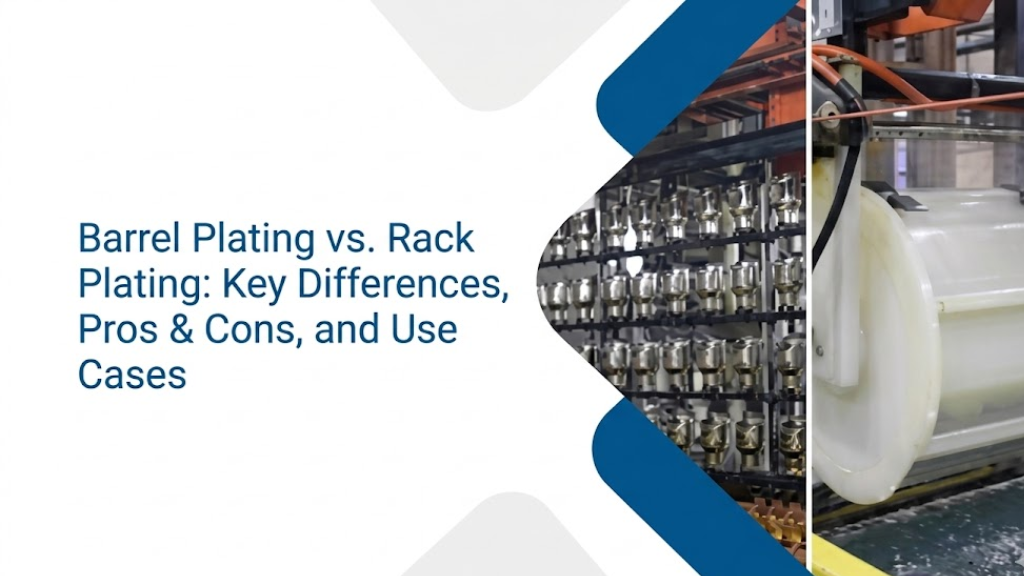
When it comes to industrial metal finishing, the method you choose can make or break the quality of your final product. At Eigen Engineering, we work with manufacturers, fabricators, and OEMs every day who face a very practical question: should we use barrel plating or rack plating? The answer is not a simple one-size-fits-all response, it depends on part geometry, material, required finish quality, production volume, and budget.
This guide breaks down both processes in detail, compares their advantages and limitations, and gives you a clear framework for making the right call on your next electroplating project.
What Is Barrel Plating?
Barrel plating is an electroplating method where small parts are loaded in bulk into a perforated, rotating barrel – typically made from polypropylene – and submerged in an electrolytic plating solution. As the barrel turns slowly, the parts tumble and cascade against each other, ensuring every surface receives consistent exposure to the plating bath and a uniform metal deposit. The barrel’s central conductive bars carry the electrical current to the tumbling parts throughout the process.
This method is ideal for high-volume production of small, durable components such as fasteners, stampings, clips, and connectors. It is cost-effective, requires minimal labor, and delivers uniform
coating across thousands of parts per batch. Common applications include corrosion protection, wear resistance and engineering finishes for industrial hardware
How Barrel Plating Works?
In barrel plating, parts are loaded in bulk into a perforated, rotating barrel, typically fabricated from polypropylene or a similar non-conductive polymer. The barrel contains central conductive bars that carry the electrical current to the parts inside.
Once loaded, the barrel is submerged into the plating bath. As the barrel rotates slowly, the parts tumble and cascade over each other. This continuous rolling movement achieves two things: it ensures every surface of each part gets exposed to the plating solution, and it provides the electrical contact each part needs to receive the metal deposit.
The result is a highly uniform coating across large volumes of small parts, efficiently and at a relatively low cost per piece.
What Parts Are Best Suited for Barrel Plating?
Barrel plating is ideal for small, robust, and geometrically simple parts that can withstand the tumbling action without deformation or damage. Common examples include:
- Bolts, nuts, screws, and fasteners
- Washers and clips
- Small stampings and pressed metal components
- Springs and wire forms
- Connectors and terminals in bulk
- Hardware components for construction and automotive assemblies
These are parts that exist in the thousands, sometimes millions, per production run. Barrel plating handles high-volume orders with ease.
Key Advantages of Barrel Plating
- Cost-effective: Lower equipment investment and minimal labor requirements translate directly into a lower per-part cost for the customer.
- High throughput: Thousands of parts can be plated in a single batch, making it ideal for mass production.
- Uniform coverage: The tumbling action ensures consistent metal deposition on all sides of each part.
- Flexible: Works well across various metals, including zinc, nickel, tin, copper, and precious metals like silver and gold.
- Less setup time: No need for individual fixturing or custom rack design.
Limitations of Barrel Plating
- Not suitable for fragile or precision parts: The tumbling action can chip, scratch, or deform delicate workpieces.
- Lower current density: Barrel plating typically uses lower electrical current, which can increase cycle times.
- Limited size range: Very large or oddly shaped components may not fit properly inside a barrel.
- Surface contact marks: Parts pressing against each other can sometimes result in minor contact marks on plated surfaces.
What Is Rack Plating?
Rack plating is an electroplating process where individual parts are mounted and secured onto metal racks using screws, wires, clips, or spring fingers before being immersed in the plating solution. Unlike barrel plating, the parts remain completely stationary throughout the process. This gives the plater precise control over part orientation, current distribution, and coating placement, making it the preferred method for large, fragile, or geometrically complex components.
Rack plating is widely used in industries where surface quality and dimensional accuracy are non-negotiable, including defense, aerospace, medical devices, automotive, and precision electronics. While more labor-intensive and costly than barrel plating, it delivers a premium finish and protects parts from any risk of tumbling-related damage.
How Rack Plating Works
Rack plating takes a fundamentally different approach to part handling. Instead of tumbling parts together in bulk, each workpiece is individually attached to a metal rack using screws, wires, clips, or spring-loaded fingers. Once all parts are secured, the rack is submerged in the plating bath.
Since the parts remain stationary throughout the process, the metal coating is applied evenly and precisely. The plater has full control over how each part is oriented, which means even complex contours, recesses, and intricate geometries can receive proper coating coverage.
This method is slower and more labor-intensive than barrel plating, but the quality and precision it delivers are unmatched for critical applications.
What Parts Are Best Suited for Rack Plating?
Rack plating is the preferred choice for parts that are large, delicate, or require a premium finish. Typical applications include:
- Aerospace and defense components with tight dimensional tolerances
- Automotive body and trim parts requiring a showroom-quality finish
- Medical implants and surgical instruments that demand contamination-free surfaces
- Electronics and PCB components with intricate circuitry
- Jewelry and decorative hardware where visual perfection matters
- Complex machined parts with undercuts, threads, or blind holes
Key Advantages of Rack Plating
- Superior finish quality: Individual handling means no contact marks, no tangling, and no surface damage.
- Precision coating control: Orientation can be adjusted to ensure proper coverage on complex geometries.
- Works with delicate parts: No risk of damage from tumbling or part-to-part contact.
- Higher current density possible: Allows for faster deposition rates on individual parts.
- Industry-grade compliance: Preferred in sectors like defense, medical, and aerospace, where certifications matter.
Limitations of Rack Plating
- Higher cost: More labor, more time, and in some cases custom-fabricated racks drive up the per-part cost.
- Lower throughput: Parts are processed individually or in small sets, making it less efficient for large volumes.
- Rack marks: Points where parts are attached to the rack may show minor unplated spots or witness marks.
- More setup required: Complex or unusual parts may require purpose-built fixtures or racks.
Step-by-Step Process Comparison
| Step | Barrel Plating | Rack Plating |
| 1 | Parts loaded into polypropylene barrel | Parts wired/screwed onto metal racks |
| 2 | Barrel submerged in electrolytic bath | Rack immersed in plating solution |
| 3 | Barrel rotates, parts tumble/cascade | Parts remain stationary; current applied |
| 4 | Uniform coating via continuous movement | Coating applied to exposed surfaces |
| 5 | Parts unloaded and inspected | Parts unracked, inspected, and finished |
Barrel vs. Rack Plating
| Factor | Barrel Plating | Rack Plating |
| Best For | Small, rugged parts | Large/delicate parts |
| Cost | Lower | Higher |
| Labor Intensity | Low | High |
| Coating Uniformity | Excellent (tumbling) | Good (stationary) |
| Finish Quality | Standard | Premium |
| Volume Suitability | High volume | Low-medium volume |
| Part Complexity | Simple shapes | Complex/intricate |
| Risk of Damage | Higher (tumbling) | Minimal |
| Industries | Hardware, fasteners | Defense, medical, auto |
Choosing the Right Plating Method: Key Decision Factors
The decision between barrel and rack plating is rarely arbitrary. Here are the key variables you and your metal plating service provider should evaluate:
1. Part Size and Weight
Small, lightweight parts are natural candidates for barrel plating. If a part is too large to tumble freely inside the barrel or too heavy to be moved without damage, rack plating is the safer option.
2. Part Complexity and Geometry
Simple shapes plate well in a barrel because every surface gets tumble-exposed. Parts with blind holes, threads, or intricate contours may need rack plating to ensure the plating solution reaches every crevice properly.
3. Material Fragility
Plastic substrates, thin-walled components, or parts with delicate surface finishes must be rack plated. Even minor collisions during barrel tumbling can cause micro-scratches or dimensional changes that would be unacceptable in precision applications.
4. Required Finish Standard
For functional hardware where appearance is secondary, barrel plating delivers adequate finish quality at lower cost. When the application demands a mirror finish, decorative appearance, or certification compliance, rack plating is the clear choice.
5. Production Volume
High-volume runs of hundreds of thousands of identical small parts? Barrel plating wins on economics. Low-volume runs of critical, high-value components? Rack plating justifies the extra cost.
6. Metal Being Deposited
Most metals, zinc, nickel, tin, copper, silver, and gold, are compatible with both processes. However, for precious metal plating like gold or silver where minimising material waste is critical, rack plating can be more cost-efficient despite its higher labor cost, since parts can be precisely positioned for optimal deposit efficiency.
Industry Applications: Who Uses Which Method?
Different industries have developed strong preferences based on their specific requirements:
Automotive: Body clips and fasteners go through barrel plating for cost efficiency; exterior trim and decorative components are rack plated for a premium appearance.
Defence and Aerospace: Mission-critical components demand rack plating for precision, consistency, and traceability. Coating failures in this sector are simply not an option.
Medical Devices: Surgical tools, implantable devices, and diagnostic equipment require rack plating to maintain biocompatibility, dimensional integrity, and surface purity.
Electronics: PCB connectors in bulk use barrel plating for zinc and tin coatings; precision contacts and RF components use rack plating for gold or silver deposits.
Industrial Hardware: Standard bolts, screws, and washers are ideal barrel plating candidates, durable, small, and produced in massive quantities.
Silver Barrel Plating and Rack Plating: A Special Case
Both silver barrel plating and silver rack plating are widely used for electrical contacts, connectors, and RF applications. Silver offers exceptional electrical conductivity and natural lubricity, but the choice of process still matters.
Silver barrel plating works well for small, high-volume connectors and pin contacts where individual handling is impractical. However, silver is a relatively soft metal, so parts that might scratch or damage each other during tumbling should instead be silver rack plated to protect surface integrity and maintain tight thickness specifications.
At Eigen Engineering, we evaluate silver plating applications on a case-by-case basis, considering contact geometry, required thickness uniformity, and downstream assembly processes before recommending the optimal method.
Conclusion
Both barrel and rack plating are proven, reliable electroplating methods, but they are designed for different problems. Barrel plating is your high-volume, cost-efficient workhorse. Rack plating is your precision, quality-first solution for critical applications.
The right choice depends on your specific part requirements: its size, shape, fragility, required finish grade, production volume, and the metal being deposited. Getting this decision right at the start of a project saves time, reduces rework, and ensures your components meet every performance specification they need to.
At Eigen Engineering, we bring deep technical expertise in electroplating processes to every project. Whether you need barrel plating for high-volume hardware, rack plating for aerospace-grade components, or guidance on which approach best suits your manufacturing goals, we are here to help you make the right call.
Frequently Asked Questions
What is the main difference between barrel plating and rack plating?
Barrel plating tumbles parts together inside a rotating container, which is cost-effective for large volumes of small, rugged parts. Rack plating holds each part individually on a stationary rack, making it the right choice for large, fragile, or high-precision components that cannot tolerate tumbling.
Is rack plating better than barrel plating?
Neither method is universally better, they serve different needs. Rack plating delivers superior finish quality and suits precision or delicate parts. Barrel plating is more economical and better suited for bulk volumes of small, durable hardware.
Which electroplating method is cheaper?
Barrel plating is significantly more cost-effective for high-volume production. The lower labour requirements and batch processing capability reduce per-part costs considerably compared to rack plating.
Can the same metal be applied by both barrel and rack plating?
Yes. Most metals used in electroplating, including zinc, nickel, copper, tin, gold, and silver, are compatible with both processes. The choice depends on part requirements, not metal type.
What industries use rack plating most?
Rack plating is heavily used in defence and military, aerospace, automotive (decorative finishes), medical devices, and precision electronics sectors, where finish quality and dimensional accuracy are non-negotiable.
What is barrel plating best used for?
Barrel plating excels in high-volume production of small hardware such as fasteners, clips, stampings, and connectors. It is the go-to process for corrosion protection on bulk industrial components.
About Author
Related Posts