
Precision Tool Manufacturers – What Requirements Should They Meet
- Precision Metal Stamping |
- Jun 13, 2026
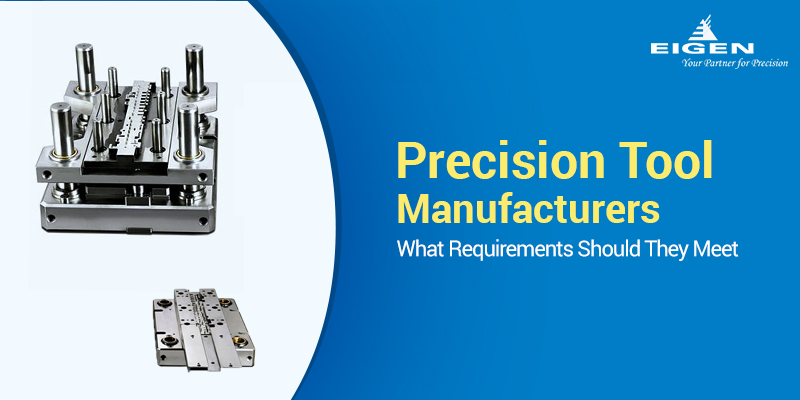
Precision tool manufacturing might be thought of as a lost art but it is far from it. Precision tool manufacturers are still providing essential services to many industries, helping produce parts and components of many commonly used items and even tools used in our day-to-day lives. Precision tool manufacturers are receiving increasing support and assistance from modern-day companies with an eye for the future, as they offer opportunities to integrate newer technology with the age-old practice of producing precision tools.
Let us first get to know what exactly is meant by precision tool manufacturing and how modern technology is utilized in carrying it out. This will also make it clear as to what requirements are to be met for those who wish to get into the field of precision tool manufacturing. Knowing this information will help you start your own business or understand what you need to look for in a service provider to be assured of the best results you require.
Understanding precision tool manufacturing–
Precision tool manufacturing falls into the realm of technical manufacturing, which is a must to produce parts or components, and also tools. Precision manufacturing or machining aims at controlling several processes which are carried out under extremely precise conditions. We may not think about it this way, but the fact remains that a large number of everyday things that we use are produced using precision tools. There are many objects that have several parts that fit snugly into one another, which require precise manufacturing so that they work smoothly and carry out the intended purpose. Precision manufacturing entails using the talents of engineers, using tools that are required and utilizing programs or software for the production of components and parts under precisely controlled circumstances. There is design involved in this process which is an integral part contributing to the overall success of the production process. With the passage of time and the advent of newer technology and means of getting the job done, the field of precision tool manufacturing has seen many improvements. The results of these advancements are a higher quality of parts that are manufactured using precision tooling, and also a reduction in the time taken to do so. The depth of art that can be witnessed in this process is when designers produce their unique designs, and using technology and computers, these designs are then engineered to be created on the machines employing several controlled and finely tuned parameters. The art and science of precision tool manufacturing ensure that high-quality tools or parts are produced, which are durable, dependable and can be repeated any number of times without compromising even a little on quality.
Applications of precision tool manufacturers–
A wide range of consumer appliances has parts and tools that are used almost every day, which are made by precision tool manufacturers. The aerospace industry, healthcare and also the automotive industry depend heavily on the production of parts and components made by precision tool manufacturers. Precision machining also helps in restoring or repairing tools and equipment that wear out or break after prolonged use. In addition, maintenance jobs like welding, grooving and even calibration are carried out by precision tools.
How is it done? Materials ranging from plastic to metals like steel, aluminium, bronze etc. can be utilised in this process. Initially, the material is cut into precise shapes using various steps. Depending on the material to be cut, the tool used for it varies. After this is done, computer-operated machines bring about nuances in the cut material to give it the precise shape, the fine finish that needs to be present for the component or part to work effectively. Large as well as small products and parts can be made with precision tools.
Work done by precision machines –
A broad classification of precision machining task includes boring, turning and milling. The basic idea in precision manufacturing is to reduce or subtract the material rather than add to get the desired shape and size. The cutting and grinding tools do just that. Boring machines create holes in the material wherever they are needed. Below are some of the machines that perform one or more of these tasks.
Milling machines-
These machines are used to grind, cut or shape materials into a particular size. These come in vertical and horizontal shapes. In such machines both the material and the tool could rotate or be set in motion. This combination of movements helps produce the right part with precise accuracy. There is a considerable amount of friction and heat generated in these machines making it imperative to use lubricants and coolants or other fluids to keep the process running. Some machines also have spindle chillers to keep a steady temperature and maintain production accuracy.
Lathe machines –
These are fairly common and are common and are used to rotate the material to be produced against a stationary tool. Modern technology has made it possible to control these machines with the help of a computer resulting in production of parts that have complex designs. These machines provide flexibility to perform a range of user specified functions. The diameter of parts produced with these machines range from decimals to many inches. Using computers and helpful programs, it is now possible to transfer the production design files directly on to the machines to start work with great speed and efficiency.
Swiss machines–
Originally, these were used to manufacture parts or components for Swiss machines however, their use has expanded to produce parts that are tiny and complex. The way this machine functions is by holding the material in place and rotating the tool. These machines provide the option to modify them, helping produce custom parts that are accurate and precisely designed.
Besides these, there are other machines like the EDM’s or electrical discharge machines which are used to cut electrically conductive metals. An electrically charged cable or electrode is used to bore a hole into the metal. These machines use wires or sinkers to make the desired cut into the metal. The electrodes of these machines can be designed with the use of precision machines to provide custom dimensions of cut metals. Another method used is laser engraving. A rotating part holds the material to be engraved or etched, and a laser performs the said task. Plastic and aluminium parts can be engraved through the use of lasers, like the markings made on medical tools. This method is widely used nowadays to engrave serial numbers, brand logos and even QR codes on different parts and products.
At Eigen, we possess all the above-mentioned requirements for a precision tool manufacturer. Ours is a company that has the juice it takes to bring about the accurate and precise end product using these tools. The process is delicate and complex and we specialize in it. With the help of our engineers, who possess a wealth of knowledge and experience, we have been carrying out complex jobs and have an impressive track record of customer satisfaction and sustainability.

Ujjwal handles crucial roles like AGM Marketing, researcher, and is an author for KDDL – Eigen. He currently works with Eigen for implementing proven techniques and strategies for marketing plans on online and offline platforms. An expert in efficiently executing SEO, SEM, email marketing, social media marketing, PR marketing, Print campaigns, etc. Ujjwal has coordinated an efficient marketing team on various creative campaigns and programmatic buying to support various digital cross-promotion efforts. Implement efficient search optimization strategies with the help of collateral material and metrics.
In his former years, Ujjwal has years of experience in a managerial role for several reputed companies. His years of experience combined with the flair of writing help him come up with result oriented strategies for Eigen.
About Author
Related Posts