
What Is the Sheet Metal Forming Process? A Complete Guide
- Sheet Metal |
- Sep 3, 2026
A flat sheet of steel doesn’t look like much on its own. But run it through the right sequence of force and tooling, and it becomes a car door, a kitchen sink, a laptop shell, or a beverage can. That transformation has a name: the sheet metal forming process, and it’s been quietly running the manufacturing world for well over a hundred years.
This guide covers what the process actually involves, the various sheet metal forming operations you’ll come across on a shop floor, the equipment behind them, where they show up in real products, and the headaches that pop up when something in the die design goes wrong. Some of this gets technical, but I’ve tried to keep it grounded in how a fabricator or engineer would actually explain it, not how a textbook would.
What Is the Sheet Metal Forming Process?
At its core, sheet metal forming is a way of shaping metal by applying force until it bends, stretches, or draws into a new form, without cutting any material away. That last part matters. Machining removes metal to get a shape. Forming just moves it around. The metal gets pushed past its yield point, deforms plastically (meaning it doesn’t spring all the way back), and holds that new shape once you let go.
“Sheet metal” itself usually refers to stock under roughly 6 mm thick. Go thicker than that and you’re really talking about plate, which needs heavier, slower equipment entirely. Most of what gets formed this way is mild steel, stainless steel, or aluminum, with copper, brass, and the occasional titanium part showing up depending on the industry.
How Does the Sheet Metal Forming Process Work?
Every sheet metal forming operation, no matter how exotic, tends to follow roughly the same script:
- A flat blank gets cut to size, usually with a laser, a shear, or a punch press.
- That blank sits between two tools: a punch, which moves, and a die, which stays put and defines the final shape.
- A press (mechanical or hydraulic) forces the punch into the die.
- The sheet deforms plastically and takes on the die’s shape.
- Someone trims the part, deburrs it, or sends it off for whatever comes next, welding, painting, assembly.
If you want a mental picture, think of pressing dough into a cookie cutter. Except the “dough” here fights back. Metal has a bit of springiness to it, and once the punch backs off, the part tries to bounce slightly toward its original flat shape. Toolmakers deal with this by overbending on purpose, or by adjusting the die geometry so the final angle lands exactly where the drawing says it should. Get this wrong, and you’ll ship a batch of parts that are all a degree or two off, which sounds minor until it’s an assembly line rejecting every one of them.
What Are the Main Sheet Metal Forming Operations?
There’s no single “forming process.” It’s really a family of methods, and which one gets used depends on the shape, the material, and how many parts you actually need. Below are the ones that show up constantly, described the way you’d see them laid out in a process diagram, punch coming down, die underneath, metal flowing between the two.
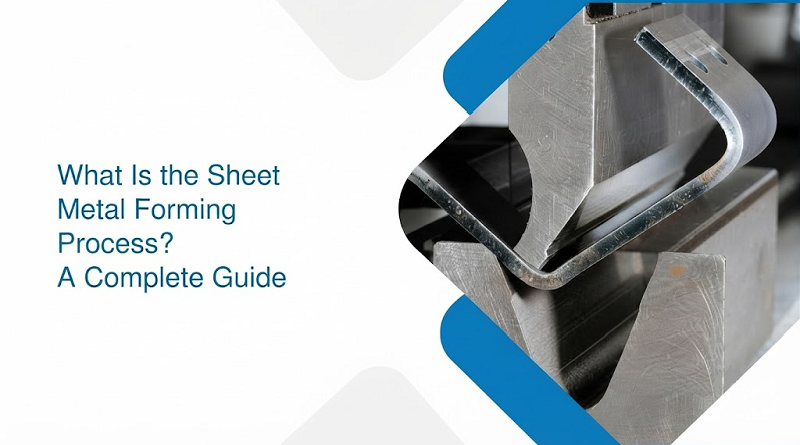
Bending is the simplest of the bunch. A straight punch presses a flat sheet into a V, U, or channel shaped die, folding it along one line. Picture a strip resting on two supports with a punch pushing down in the middle until it creases into an angle. Almost every press brake in the world is doing exactly this, all day long, for everything from electrical enclosures to structural brackets.
Deep drawing goes further than a simple crease. A punch pulls a flat blank down into a die cavity, and the metal flows inward to form a hollow shape, a cup, a sink basin, a fuel tank. A blank holder clamps around the edge of the sheet while this happens, because without it the material would just wrinkle up rather than flowing smoothly. This is how a two-piece beverage can gets its shape, in a couple of aggressive drawing passes.
Stamping is more of an umbrella term than a single operation. It covers punching, blanking, piercing, coining, flanging, whatever you’re doing inside a stamping press. In high volume work, a strip of metal runs through a progressive die with several stations lined up in sequence, and each station does one job, punch a hole here, bend a flange there, until a finished part drops off the end. This is basically the entire story behind automotive body panels.
Roll forming works differently from anything using a single die stroke. A long strip runs through a series of rollers, and each roller bends the profile a little further than the last one, until the final cross section shows up at the far end. It looks almost like a conveyor line gradually curling the metal as it travels. Gutters, rails, and metal studs are basically all made this way because the profile stays constant along a long length.
Stretch forming clamps both ends of a sheet and pulls it taut over a form block until the sheet takes on the block’s contour. Aerospace leans on this heavily for large curved skin panels, aircraft fuselage sections and wing panels especially, because it produces smooth, wrinkle free surfaces on parts that are simply too big for a drawing die.
Spinning rotates a flat disc on something like a lathe while a roller tool presses it gradually against a rotating mandrel underneath. It’s a slower, often semi manual process, but the tooling is cheap compared to a stamping die, which makes it a solid choice when you only need a few hundred bowls, cones, or light fixture shells rather than a few hundred thousand.
Hydroforming swaps the solid punch for pressurized fluid. In tube hydroforming, a tube sits inside a closed die, and internal pressure pushes the tube outward until it fills the cavity completely. Exhaust components, bicycle frames, and structural automotive parts often come out of a hydroforming press in a single hit, where a stamped and welded version might’ve needed several separate pieces.
Incremental forming is the newer arrival on this list. A CNC controlled tool traces a path across the sheet point by point, gradually pushing it into shape without any dedicated die at all. It’s slow, not something you’d choose for mass production, but for prototypes or one off custom parts it saves a ton of tooling cost since there’s no die to build in the first place.
Punching and blanking look almost identical on paper, a punch coming down through a die, but the difference is which piece of metal you actually want. Punching removes material to leave a hole. Blanking cuts the outer profile and keeps the piece that fell out. Same motion, opposite goal.
What Materials Work Best for Sheet Metal Forming?
Not every metal behaves the same way under a punch. Material choice ends up affecting tooling cost, achievable bend radius, and honestly whether the part is even feasible to make this way.
- Mild steel: cheap, forgiving, the default choice for most parts.
- Stainless steel: corrosion resistant, but it fights back harder and needs tighter control over bend radius.
- Aluminum: light and easy to shape, a favorite in automotive and aerospace work.
- Copper and brass: form nicely, often chosen for electrical components or decorative pieces.
- Titanium: strong, expensive, and genuinely stubborn to bend. Mostly reserved for aerospace where the weight savings justify the trouble.
Grain structure, thickness, and hardness all decide how far a given sheet can stretch before it cracks. That’s exactly why shops run formability tests on new materials before cutting an expensive die around them.
Where Is Sheet Metal Forming Actually Used?
Sheet metal applications are everywhere once you start looking. Here’s a rough breakdown by industry:
- Automotive: body panels, chassis components, fuel tanks, brackets
- Aerospace: fuselage skins, wing panels, engine housings
- Appliances: refrigerator panels, washing machine drums, oven housings
- HVAC: ductwork, vents, enclosures
- Electronics: laptop and server chassis, brackets, enclosures
- Packaging: beverage cans, food tins, aerosol containers
- Construction: roofing panels, wall cladding, structural framing
- Medical: surgical trays, equipment housings, implant components
If a product has a metal shell and needs to stay light, there’s a decent chance forming was involved somewhere in making it.
What Equipment Runs These Sheet Metal Forming Operations?
The equipment lineup depends entirely on which operation you’re doing:
- Press brakes handle bending.
- Mechanical or hydraulic stamping presses cover punching, blanking, and general stamping work.
- Roll forming lines take care of long, constant cross section parts.
- Spinning lathes handle round, symmetrical shapes.
- Hydroforming presses manage tube and sheet hydroforming.
- CNC laser or plasma cutters prep the blanks before any of the above even starts.
Bigger operations tend to string several of these together into one line. A car body panel might get blanked, formed, and trimmed in a single coordinated sequence without a human touching it between stations.
Advantages and Limitations of the Sheet Metal Forming Process
What it’s good at:
- Fast production once the tooling exists
- Very little wasted material compared to machining
- Stronger parts, since grain flow isn’t cut through
- A wide range of achievable shapes depending on which operation you pick
- Cost effective once you’re at scale
Where it struggles:
- Tooling and die costs get expensive fast for complex geometry
- Small production runs don’t justify the tooling investment unless you’re using spinning or incremental forming
- Thickness limits mean it’s not the right choice for heavy structural parts
- Springback and wrinkling demand careful upfront engineering, or you’ll be reworking parts later
Final Thoughts
There isn’t really one “sheet metal forming process.” It’s a toolbox of sheet metal forming operations, each one suited to a different shape, material, and production volume, and picking the wrong one is usually where projects run into trouble. A stamped car door, a spun light fixture, a hydroformed exhaust pipe, they all trace back to the same basic idea: apply force in the right place, and flat metal turns into something useful.
Knowing which process actually fits your part, and which quality issues to plan around before cutting a die, is usually what separates a smooth production run from an expensive do-over.
Frequently Asked Questions
Is sheet metal forming the same thing as sheet metal fabrication?
No, Fabrication is the umbrella term, it includes cutting, forming, welding, and final assembly. Forming is just the piece of that puzzle where the shape actually gets created through bending, drawing, or stretching.
Isn’t stamping basically the same as forming?
Stamping is one operation inside the broader forming category. It handles punching, blanking, and bending in a press, but forming as a whole also covers spinning, hydroforming, roll forming, and a few others that don’t involve a stamping press at all.
How thick can metal be and still count as “sheet metal”?
Roughly under 6 mm, depending on who you ask. Past that thickness, it’s usually called plate, and it needs entirely different equipment to form.
I only need 50 parts. Which process makes sense?
Spinning or incremental forming, most likely. Neither needs a dedicated die, so you skip the tooling cost that would make stamping or deep drawing painfully expensive for such a small batch.
Why does a bent part never quite match the angle on the drawing?
That’s springback. The metal has some elastic recovery even after it’s been permanently deformed, so it creeps back slightly once the punch releases. Overbending or adjusting the die angle compensates for it.
About Author
Related Posts