
What Are CNC Precision Machining Parts?
- CNC Machining |
- Aug 21, 2026
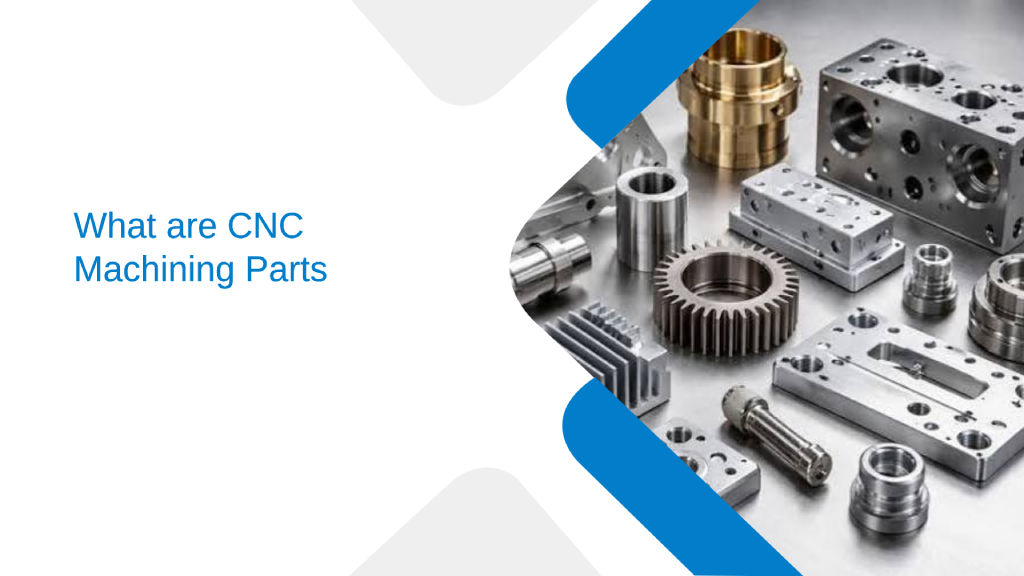
Quick answer: CNC machining parts are components made by feeding a digital design into a computer-controlled machine tool, a mill, lathe, or router, that cuts material away from a solid block until only the finished shape is left. They show up everywhere from aircraft brackets to surgical implants because the process holds tight tolerances and repeats accurately, part after part, batch after batch.
If you’ve ever picked up a metal bracket, a gear, or a smooth aluminum housing and wondered how something that precise gets made without a single hand tool touching it, the answer is almost always CNC machining. Computer Numerical Control has become the default way manufacturers turn raw stock into finished parts for aerospace, automotive, medical devices, electronics, and heavy industry, and understanding how it works helps when you’re specifying, sourcing, or quoting a part.
What Exactly Is a CNC Machining Part?
A CNC machining part starts as a 3D CAD model. That file is translated into G-code, the instruction set a CNC machine actually reads, and the machine then cuts, drills, or turns away material from a block, bar, or billet in controlled passes until the geometry matches the design. Nothing is added, only removed, which is why the process falls under “subtractive manufacturing,” as opposed to 3D printing (additive) or injection molding (formative).
Common equipment used to produce these parts includes:
- 3-axis and 5-axis CNC milling machines
- CNC lathes and turning centers
- Machining centers with automatic tool changers and in-process probing
- CNC routers and grinders for specific finishes or materials
What Materials Are CNC Machining Parts Made From?
Almost any rigid material can be CNC machined, and the choice usually comes down to strength, weight, cost, and how the part will be used:
- Metals: aluminum, stainless steel, carbon steel, titanium, brass, copper
- Plastics: nylon, acetal (Delrin), PEEK, polycarbonate, ABS
- Composites and engineering polymers for lightweight or corrosion-resistant applications
Aluminum remains the most common choice for prototypes and general industrial parts because it machines quickly and is comparatively inexpensive. Titanium and hardened steels show up where strength-to-weight ratio or heat resistance matters more than machining speed or cost.
What Do CNC Machining Parts Actually Do?
Structural Support
Brackets, housings, and frames produced on CNC mills and lathes give assemblies the rigidity and dimensional stability they need to hold everything else in place.
Motion and Power Transmission
Shafts, gears, couplings, pulleys, and bearing seats are almost always CNC machined, since even small errors here translate directly into vibration, wear, and energy loss.
Fluid and Gas Control
Valves, manifolds, pump bodies, and pneumatic fittings depend on precisely machined internal channels and sealing surfaces to stay leak-free under pressure.
Heat Management
Heat sinks and cooling plates rely on accurate surface contact to dissipate heat efficiently, a tolerance issue as much as a design one.
Precision Alignment
Locating pins, fixtures, and gauging components exist purely to keep everything else in position, so they’re held to some of the tightest tolerances in a build.
How Is a CNC Machining Part Actually Made? (Step-by-Step)
Every CNC part, regardless of complexity, moves through roughly the same eight stages from digital design to shipped component:
| Step | Stage | What Happens |
|---|---|---|
| 1 | Design (CAD) | Engineers build a 3D model that defines every dimension, tolerance, thread, and surface finish the part needs. |
| 2 | CAM Programming | The CAD file is converted into G-code, the toolpaths, spindle speeds, feed rates, and cutting sequence the machine will follow. |
| 3 | Material Selection | Stock is chosen based on strength, weight, cost, and application; regulated industries often require material traceability certificates. |
| 4 | Workholding | The stock is clamped in a vice, chuck, or fixture. Even slight movement here can ruin a part or damage a tool. |
| 5 | Roughing | The machine removes the bulk of the excess material quickly, leaving a small allowance for finishing passes. |
| 6 | Finishing | Lighter cuts and smaller tools bring the part to final dimensions, tight tolerances, and the specified surface finish. |
| 7 | Inspection | Calipers, micrometers, and Coordinate Measuring Machines (CMMs) verify the part against the CAD drawing. |
| 8 | Cleaning & Packaging | Chips and coolant are removed, parts are labeled and documented, then packed for shipping. |
What Are the Advantages of CNC Machining Parts?
- Tolerances measured in microns, often ±0.005 mm on precision work
- Consistent repeatability across thousands of identical parts
- Wide material compatibility, from soft plastics to hardened alloys
- Fast turnaround on prototypes since design changes only require a new program, not new tooling
- Lower dependence on manual operator skill, which reduces human error on critical dimensions
CNC Machining Parts: US vs. India Sourcing
Buyers in the US typically lean on CNC machining for tight-tolerance, certification-heavy work, aerospace brackets, medical instruments, defense components, where ITAR compliance, AS9100 or ISO 13485 certification, and domestic supply chains matter as much as price. Reshoring efforts over the past few years have also pushed more prototype and low-volume work back to US-based shops for speed and IP control.
India has become a genuinely competitive option for CNC-machined parts, particularly for mid-volume production and export manufacturing. A growing base of ISO 9001 and AS9100–certified job shops, lower per-hour machining costs, and government initiatives such as Make in India and various production-linked incentive (PLI) schemes have made Indian manufacturers a realistic alternative, not just for cost, but increasingly for capability. Companies sourcing from India should still vet a shop’s quality system and inspection equipment (CMM access matters) before committing to tight-tolerance work.
Bottom Line
CNC machining parts are engineered components produced through computer-controlled subtractive manufacturing, and the process behind them, from CAD model to CMM inspection, is what makes them accurate enough for aerospace, medical, and industrial use. Whether you’re sourcing domestically in the US for certification-critical work or evaluating Indian suppliers for cost-competitive production, the fundamentals of a good CNC part stay the same: a solid CAD model, a well-programmed CAM toolpath, the right material, and a shop that actually inspects what it ships.
Frequently Asked Questions
Q1 What’s the difference between CNC machining and 3D printing?
CNC machining removes material from a solid block (subtractive); 3D printing builds a part up layer by layer (additive). CNC generally gives stronger, more dimensionally accurate parts; 3D printing wins on complex internal geometries and very low-volume runs.
Q2 How tight a tolerance can CNC machining hold?
Standard CNC machining typically holds ±0.05 mm to ±0.1 mm. Precision CNC work, common in aerospace and medical parts, can reach ±0.005 mm to ±0.01 mm depending on the machine, material, and geometry.
Q3 Is CNC machining cost-effective for small batches?
Yes, more so than injection molding or casting, because there’s no tooling to build. A design change is just a new program, which is why CNC is the default choice for prototypes and low-volume production.
Q4 How is a CNC machined part different from a cast part?
Casting shapes molten material in a mold, which is cheaper at very high volumes but less precise. CNC machining cuts to exact dimensions from solid stock, giving tighter tolerances and better mechanical properties, at a higher per-part cost for large runs.
About Author
Related Posts