

Barrel Plating: Process, Method & Benefits
- Plating |
- May 18, 2026
Barrel Plating: Process, Method & Benefits
If you have ever wondered how thousands of tiny screws, washers, or connectors get a smooth, even metal coating all at once, the answer is usually barrel plating. It is one of the most practical and widely used finishing methods in modern manufacturing, and at Eigen Engineering, we rely on it every day to deliver durable, corrosion-resistant parts at scale. In this guide, we walk through what barrel plating actually is, how the method works, the step-by-step process, and why so many industries depend on it.
What Is Barrel Plating?
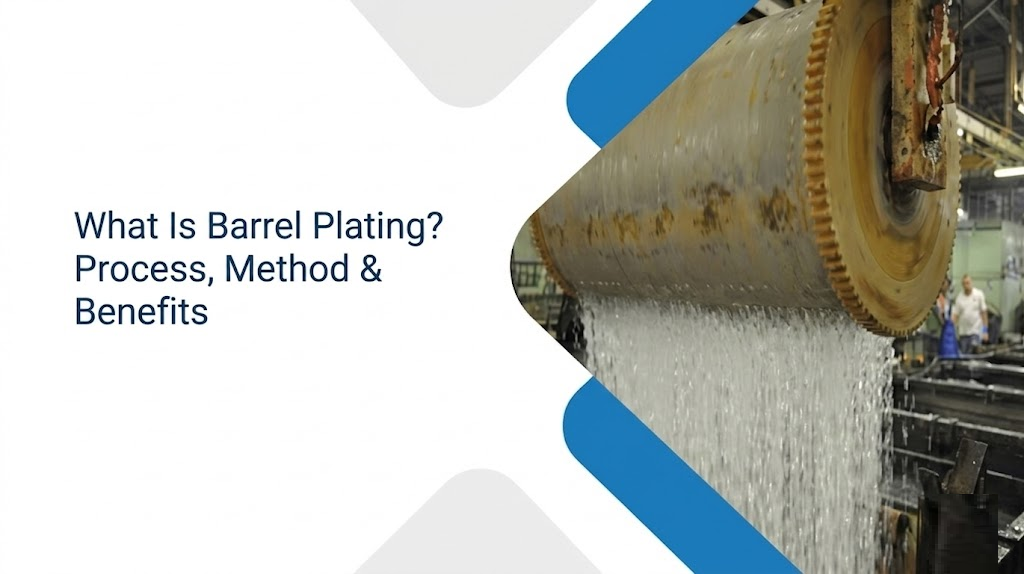
Barrel plating is a type of electroplating used to coat a large quantity of small metal parts in a single batch. Instead of holding each piece individually, the parts are loaded together into a rotating, non-conductive barrel that is then lowered into a chemical plating bath. As the barrel slowly turns, the parts tumble over one another, and an electric current drives metal ions from the solution onto every exposed surface.
This tumbling is the heart of the method. Because the pieces are constantly moving and touching, they pass current to each other through what is called bipolar contact, which keeps plating efficiency high and helps the coating build up evenly across the whole batch. The trade-off is that all that part-to-part contact makes barrel plating less suited to precisely engineered or purely decorative finishes, where rack plating tends to win out. For high volumes of robust small components, though, it is hard to beat.
Fundamentals of Barrel Plating
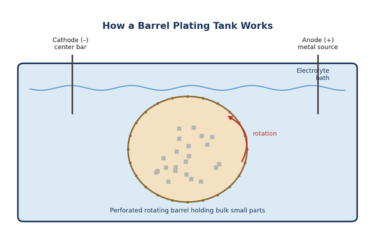
To understand barrel plating, it helps to know the basic ingredients that make it work. Every barrel plating line, including the systems we run at Eigen Engineering, brings together a handful of core elements:
- The barrel: a perforated, non-conductive drum, usually made from polypropylene or acrylic. The holes let the electrolyte flow in and out freely while keeping the parts contained.
- The electrolyte bath: a chemical solution containing dissolved metal ions, such as zinc, nickel, tin, or copper, that will form the coating.
- The cathode connection: center bars or danglers inside the barrel that carry the negative charge to the parts, which act as the cathode.
- The anode: the positively charged metal source that supplies the ions deposited onto the parts.
- Rotation: slow, steady turning (often around 10–15 rpm) that keeps parts moving so every surface gets coated.
Interestingly, barrel plating is not new. The technique first appeared in the United States during the Civil War era, but it could not be used widely until chemically resistant plastics like polypropylene and acrylic were developed, since the harsh plating chemicals destroyed earlier materials. By the early 2000s the method had become the workhorse of the industry, with a large majority of electroplating facilities using barrel techniques for small parts.
Barrel Plating Method of Electroplating
Barrel plating is one branch of the broader family of electroplating. All electroplating relies on the same underlying principle: an electric current is passed through a conductive solution, causing metal ions to leave the solution and bond to the surface of a workpiece. What sets each method apart is how the parts are held and moved during that process.
There are three common approaches, and choosing between them comes down to part size, geometry, finish quality, and production volume:
| Barrel plating | High volumes of small, durable parts like screws and connectors | Bulk processing, low cost per part |
| Rack plating | Larger, fragile, or complex parts needing precise finishes | Parts held individually on fixtures |
| Brush plating | Spot repairs and selective coating on specific areas | Localized, portable application |
As a method, barrel plating shines when you need consistency across thousands of identical parts without the labor of mounting each one by hand. The continuous tumbling exposes fresh surfaces to the solution and prevents parts from welding together, which is why it is the default choice for fasteners, hardware, and electronic components.
Barrel Plating Process Step by Step
While the exact recipe changes depending on the coating metal and the customer’s specification, the barrel plating process generally follows the same sequence:
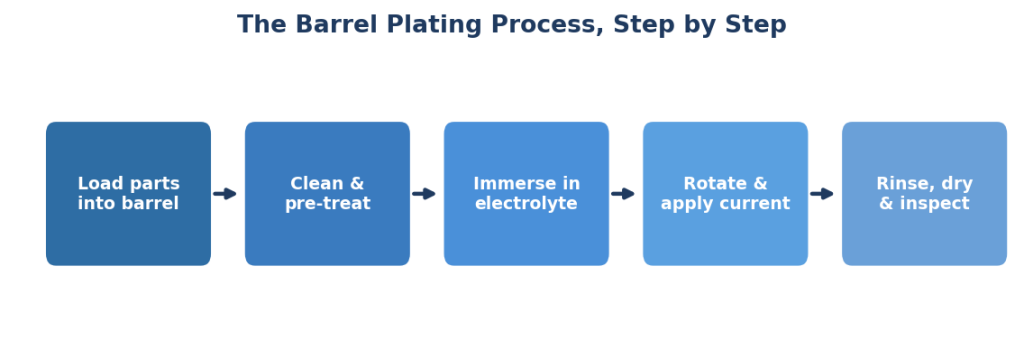
- Loading: The cleaned small parts are weighed and loaded into the perforated barrel. Operators avoid overfilling so the parts can still tumble freely.
- Cleaning and pre-treatment: Parts are degreased, rinsed, and often acid-activated to strip away oils, oxides, and dirt. A clean surface is essential for the plating to bond properly.
- Immersion: The sealed barrel is lowered into the electrolyte bath containing the metal ions to be deposited.
- Rotation and current: The barrel rotates slowly while a controlled electric current flows through the center bars. The parts cascade over one another, and metal builds up evenly on every surface.
- Rinsing, drying, and inspection: After plating, the parts are rinsed to remove chemical residue, dried (often in a centrifugal spin dryer), and inspected for coating thickness and coverage.
Throughout the cycle, factors like current density, rotation speed, bath temperature, and immersion time are carefully controlled. Getting this balance right is what separates a uniform, defect-free finish from one with bare patches or uneven thickness, and it is where experienced platers earn their keep.
Advantages of Barrel Plating
Barrel plating has earned its place in manufacturing for good reason. Its strengths are most obvious when you are dealing with high volumes of small parts:
Mass processing: a single barrel can hold hundreds or even thousands of parts and plate them all in one cycle, dramatically increasing throughput.
Lower cost per part: because parts are handled in bulk rather than mounted individually, labor and handling costs drop sharply.
Even, uniform coverage: the constant tumbling exposes all surfaces to the solution, producing a consistent coat even on oddly shaped parts.
Faster turnaround: the cascading action promotes efficient deposition, helping shorten production timelines.
Excellent corrosion and wear protection: typical applications add a protective layer that guards parts against rust, abrasion, and everyday wear.
Scalability: automated lines let a single operator manage several barrels at once, making it easy to scale up for large orders.
It is worth being honest about the limits, too. Barrel plating is not ideal for very large, heavy, or delicate parts that could be dented or deformed by tumbling, and thin flat pieces can occasionally stick together and leave small unplated spots. For parts that demand extreme precision on a specific face, rack plating may be the better call. For the vast majority of small, sturdy components, though, the advantages clearly outweigh the drawbacks.
Common Applications
Because so many products rely on small plated parts, barrel plating touches almost every manufacturing sector. Typical examples include:
- Fasteners such as screws, bolts, nuts, washers, and rivets
- Electrical and electronic components like pins, terminals, and connectors
- Automotive hardware and small stampings
- Springs, clips, and other formed wire parts
- Decorative and functional hardware that needs corrosion resistance
Barrel Plating with Eigen Engineering
At Eigen Engineering, barrel plating is part of how we help customers deliver reliable, long-lasting products. By combining well-controlled process parameters with careful pre-treatment and inspection, we produce coatings that protect against corrosion, improve wear resistance, and meet tight quality standards, all at the volumes modern manufacturing demands. Whether you need zinc-plated fasteners by the thousand or a speciality finish on small precision components, the right plating method makes a measurable difference to the life of the part.
Frequently Asked Questions
What is barrel plating used for?
Barrel plating is used to apply a metal coating, such as zinc, nickel, tin, or copper, to large quantities of small parts at once. It is most common for fasteners, connectors, springs, and similar hardware that need corrosion protection or improved wear resistance.
What is the difference between barrel plating and rack plating?
In barrel plating, many small parts tumble together inside a rotating drum, making it ideal for high volumes and low cost per part. In rack plating, each part is mounted individually on a fixture, which suits larger, fragile, or precisely finished parts but costs more per piece.
How does the barrel plating process work?
Parts are cleaned and loaded into a perforated, non-conductive barrel, which is then immersed in an electrolyte bath. As the barrel rotates and an electric current is applied, metal ions deposit evenly onto every surface, after which the parts are rinsed, dried, and inspected.
What are the main advantages of barrel plating?
The biggest advantages are high-volume mass processing, lower cost per part, uniform coverage from continuous tumbling, faster turnaround, and strong corrosion and wear protection, making it the go-to choice for small, durable components.
About Author
Related Posts