
What Is Precision Tooling and Why Does It Matter in Manufacturing?
- Metal Stamping |
- Jan 15, 2026
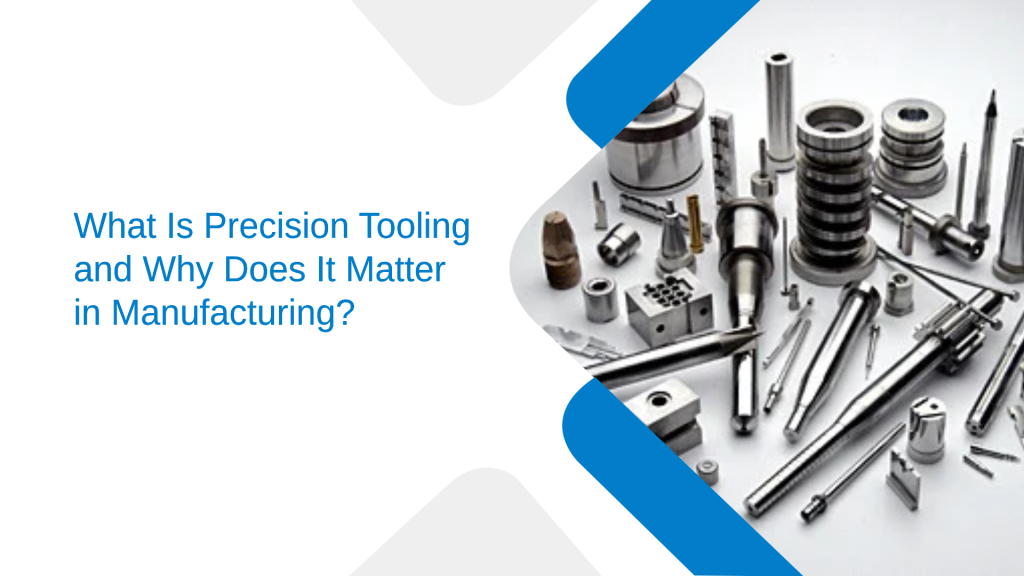
Precision tooling is essential in modern manufacturing to provide manufacturers with the most accurate, consistent and efficient products possible. The factors that allow the manufacture of precision tooling are also some of the most important in order to create the foundation of excellence in today’s manufacturing industry.
Precision tooling includes everything from highly intricate and detailed parts to high volume production capabilities. Precision tooling creates the basis of excellence in manufacturing.
At Eigen, precision tooling is a core manufacturing capability. It is a business resource that facilitates high-quality artisanship, productivity, and effective production. Understanding what precision tool supply is and why it matters allows manufacturers to make informed decisions that directly impact product quality and long-term performance.
What Is Precision Tooling?
Precision tooling refers to the design, development, and use of highly accurate tools, dies, moulds, jigs, and fixtures that operate within extremely tight tolerances. These tools are designed to ensure that all manufactured parts remain consistent and uniform across every production cycle.
Precision tooling uses advanced manufacturing methods, including CNC Machining, Electrical Discharge Machining (EDM), and Precision Grinding, in conjunction with the use of Computer-Aided Design (CAD) systems, to provide the necessary degree of accuracy, repeatability and dependability required for Critical Applications, where Performance and Precision are of utmost importance.
Key Features of Precision Tooling
Extreme Accuracy: Precision tooling is designed to meet extremely precise dimensional requirements, typically in microns, enabling components to satisfy all production steps’ strict tolerance standards.
Consistency and Repeatability: With precision tooling, every part produced will have identical performance characteristics. This consistent performance is essential to ensure that products will be reliable and can be assembled seamlessly throughout the entire duration of their use.
Advanced Manufacturing Technology: During the process of manufacturing precision tooling, Computer-Aided Design (CAD) and Computer Numerical Control (CNC) machining are used to develop and create unique designs and guarantee accurate implementation while allowing for automated, repeatable manufacturing processes.
High-Quality Tooling Materials: The production of precision tools comes from hardened steels, carbides, and specialized alloys providing the greatest durability, wear resistance, and dimensional stability in demanding environments.
Critical Industrial Applications: Precision tooling is crucial to industries like medical devices, aerospace, defense, and semiconductor technology, where the level of accuracy and reliability must be maintained and where there cannot be a tolerance for failure.
How Precision Tooling Works?
Design: Engineers take advantage of the latest CAD technologies available to create three-dimensional models of each tool and its individual parts. These models include all characteristics that are necessary to produce the finished products: dimensional specifications, tolerances, or performance specifications.
Fabrication: CNC machining and EDM technologies are utilized for cutting and shaping high-quality material with extreme accuracy to produce tooling products that provide the highest level of durability and dependability.
Integration: After production, the integration between the tool and the production process is performed, providing for the symmetrical tooling to manufacture complex shapes that produce accurate assembly and repeatability.
Quality Control: Advanced inspection techniques and measuring equipment provide continuous verification of the tooling produced during the production process by ensuring they meet specifications for dimensional accuracy and functional capability.
Why Precision Tooling Matters in Manufacturing?
The importance of precision tooling extends beyond operational accuracy and directly impacts overall manufacturing performance. It has a direct effect on cost effectiveness, speed of production, material optimisation and the overall product reliability.
Enhanced Product Quality and Consistency
Precision tooling ensures uniformity across all manufactured components. Manufacturers will be able to generate parts that are flawless in line with design specifications by ensuring that their tolerances are kept to a minimum. This consistency enhances quality control, ease in assembly and eliminates chances of rework or rejection.
High-quality precision tooling also ensures surface finishes, dimensions, and structural integrity remain consistent throughout production runs.
Improved Manufacturing Efficiency and Speed
Manufacturing processes supported by precision tooling operate with higher efficiency. Metal stamping, forming, and cutting processes are highly automated, high-speed operations that depend on precise tooling solutions to allow a reduction in the cycle time and maximisation of throughput.
By reducing errors and interruptions, precision tooling allows manufacturers to meet tight production deadlines while maintaining quality standards.
Cost Efficiency and Long-Term Value
Although precision tooling may require a higher initial investment, it delivers substantial long-term cost savings through reduced waste, fewer defects, and improved efficiency. Minimised waste of materials, decreased number of secondary processes, reduced levels of defect and reduction of time wastage lead to increased profitability in the long run.
Precision tooling also enables manufacturers to undertake both high-volume production and specialised custom projects without excessive setup costs, making it a cost-effective solution across diverse manufacturing needs.
Reduction of Material Waste
The issue of material optimisation is a significant manufacturing problem. Precision tooling minimises waste by ensuring accurate cutting and forming, leaving minimal excess material. Complex tooling processes enable several parts to be made with a limited amount of work, a sheet, or a workpiece.
This would minimise the costs of production, besides promoting environmentally friendly manufacturing processes.
Supporting Complex Designs and Advanced Geometry
Manufacturing processes in the modern world are becoming increasingly demanding in terms of design and complicated geometries. Precision tooling enables the accurate production of detailed components without compromising structural integrity or dimensional accuracy.
This feature is especially valuable when a smaller design and smaller tolerances, as well as multifunctional elements, are needed in industry. Precision tooling allows manufacturers to innovate while maintaining high standards of performance and reliability.
Minimising Secondary Operations
One of the key advantages of precision tooling is the reduction or elimination of secondary manufacturing processes. Holes, threads and countersinks are some such features that may be directly added during primary manufacturing.
Manufacturers save production time and reduce labour costs, and potential causes of error through minimisation of the steps of additional machining or finishing, hence resulting in a quick time-to-market.
Flexibility for Customisation and Prototyping
Precision tooling supports customisation and rapid prototyping, which are increasingly important in today’s competitive manufacturing landscape. The tooling designs can be easily reconfigured to suit unconventional client needs without reconfiguring on a large scale.
This flexibility enables the businesses to react to the changing market needs, easily test new product designs and easily take a step from the prototype to a full-scale production with certainty.
Industry Applications of Precision Tooling
Precision tooling is essential for many industries because small deviations can lead to serious functional failures or safety concerns. These Industries Include:
Aerospace: Precision tooling is used to create Turbine Blades, Engine Housings and Structural Components that must withstand extreme temperature, pressure, mechanical stress, etc.
Medical Devices: Precision tooling, therefore, allows surgeons to develop surgical instruments and implants, for which high quality is fundamentally important.
Semiconductors: Precision tooling can, for example, be applied to the production of a large number of parts, such as Silicon Wafer Dicing and Chip Fabrication. Such processes require a very high level of accuracy with respect to Nano-tolerances.
Automotive: Precision tooling is extremely important in the production of systems, such as Fuel Injection Systems, Transmission Gears and Other critical components, that need to function reliably and consistently.
Role of Precision Tool Supply
A high level of consistency in manufacturing depends on the precision tool supply. Use of high-quality tooling materials, proper fabrication and highly reliable delivery schedules will guarantee continuity in production and quality production output.
The fact that the dependability of precision tools is so highly considered at Eigen has ensured that all tools comply with high standards of performance and durability as a means of enhancing the long-term success of the operations.
Why Precision Tooling Is Essential for Eigen?
Precision tooling is essential to Eigen’s ability to provide refined workmanship and dependable manufacturing results. Through precision tooling solutions, Eigen can produce optimum levels of accuracy, produce optimal workflow efficiency, and maintain continuity of quality across all projects.
Through precision tooling solutions, Eigen can achieve its customers’ demanding specifications, support their customers’ complex requirements during manufacturing, and uphold excellence throughout the entire process of manufacturing.
Read Also: The Importance of Precision Stamping Tools in Modern Manufacturing
Conclusion
Precision tooling is a cornerstone of modern manufacturing, enabling accuracy, efficiency, and consistency at every stage of production. From improving product quality and reducing waste to supporting complex designs and cost-effective scalability, precision tooling delivers measurable value to manufacturers.
With the benefits of up-to-date precision tools, precision tool supply, and designed, correct tooling approaches, manufacturers will be able to reinforce operational execution and be competitive in the changing industrial environment.
At Eigen, precision tooling is a commitment to quality, reliability, and manufacturing excellence, ensuring that every component reflects precision-driven craftsmanship and enduring value.
About Author
Related Posts