
What Is Mechanical Assembly? Process, Types & Best Practices
- Assembly and Sub Assembly |
- Apr 10, 2026
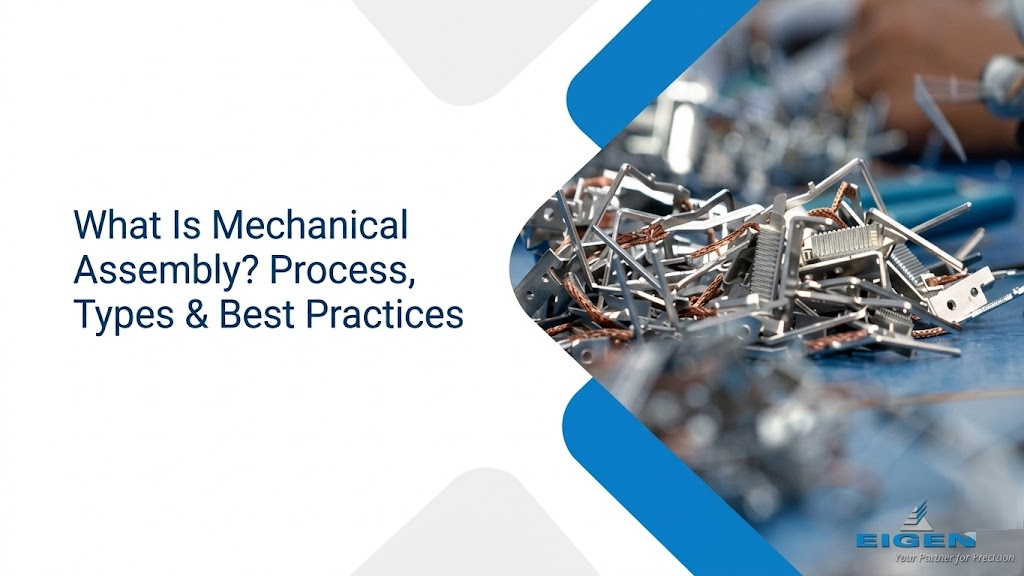
Every machine you’ve ever used, from the car parked outside your door to the medical device that saved a life, began as a collection of separate parts. Someone had to bring those parts together, precisely and reliably. That process is called mechanical assembly, and it sits at the very core of modern manufacturing.
In this guide, we break down exactly what mechanical assembly is, how it works, which types exist, what the step-by-step process looks like, and why getting it right makes all the difference in product quality and longevity.
What Is Mechanical Assembly?
Mechanical assembly is the process of joining two or more individual components, such as gears, shafts, pins, brackets, and fasteners, into a single functional unit. It typically happens at the end of the manufacturing production chain, after each part has already been machined, treated, or otherwise prepared.
Unlike basic assembly, mechanical assembly is held to extremely tight dimensional tolerances. It relies on precision instruments, micrometres, inspection jigs, gauges, and automated assembly machines, and is performed by skilled technicians known as mechanical assemblers. The result is a unit where every component fits, moves, and functions exactly as it was designed to.
Types of Mechanical Assembly
Not all assemblies are the same. The method chosen depends on the product’s function, maintenance requirements, and performance environment. Here are the three main categories:
1. Rigid Assemblies
These are designed to hold their shape and structure under load. Think engine blocks, gearboxes, or structural frames. Rigid assemblies typically use permanent joining methods such as welding, brazing, or high-strength adhesives, and they’re built for maximum stability.
2. Flexible Assemblies
Built to accommodate movement or deformation, flexible assemblies include components like hydraulic hoses, belts, seals, and cable harnesses. They must maintain integrity under vibration, flexion, and dynamic loads, quite different engineering challenges from rigid structures.
3. Hybrid Assemblies
These combine rigid and flexible elements to meet complex performance requirements. Robotic arms, vehicle suspension systems, and precision medical devices are classic examples, they need structural rigidity in some areas and controlled flexibility in others.
Core Principles of Mechanical Assembly
Material Selection
Every material, metal, plastic, ceramic, or composite has its own tensile strength, hardness, ductility, and corrosion resistance. These properties must be matched to the application. Choosing the wrong material doesn’t just affect performance; it can cause catastrophic failure over time.
Dimensional Tolerances
Tolerances define the acceptable deviation from a specified dimension. In mechanical assembly, adhering strictly to tolerances is non-negotiable. A difference of even a few hundredths of a millimetre can mean the difference between a part that fits and one that fails. This is why mechanical assemblers often work with infra-decimal precision.
Automation and Quality Control
CNC machines and industrial robots bring repeatability and speed that human hands simply cannot match at scale. Paired with machine vision systems and inline sensors, modern assembly lines can detect deviations in real time, catching errors before they propagate down the line and cost more to fix.
Sustainability
Mechanical assembly increasingly reflects circular economy values. Processes are being redesigned to minimise waste, extend component service life, and simplify disassembly for recycling. Choosing non-permanent fastening methods where possible, for example, makes end-of-life component recovery significantly easier.
Manufacturing Process Steps For Mechanical Parts Assembly
While the specifics vary by industry and product, most mechanical assembly processes follow these fundamental stages:
Step 1: Planning and Design Review
Before a single component is touched, the assembly team reviews engineering drawings, specifications, and design-for-assembly (DFA) guidelines. The goal here is to identify potential issues, clashing tolerances, difficult-to-reach fasteners, and unnecessary part counts before they become problems on the line.
Step 2: Cleaning and Component Preparation
All incoming parts must be thoroughly cleaned to remove contaminants, burrs, machining residue, and oxides. Surfaces are then treated with lubricants, coatings, or sealants as required. Skipping or rushing this step is a common root cause of assembly failures and premature wear.
Step 3: Alignment and Positioning
Using precision jigs, fixtures, and locating pins, components are carefully aligned and positioned relative to each other according to the design specifications. Correct orientation at this stage is critical, errors here cascade through every subsequent step.
Step 4: Preliminary Fastening
Temporary fasteners, pins, clamps, or provisional screws hold components in position while the permanent assembly work is completed. This prevents shift or misalignment during the joining process.
Step 5: Final Joining and Torque Verification
Permanent fastening methods are now applied, whether welding, adhesive bonding, or tightening threaded fasteners to their specified torque values. Torque verification is essential: under-torqued fasteners can loosen under vibration; over-torqued ones can strip threads or stress the substrate material.
Step 6: Inspection and Quality Control
Inspection doesn’t happen only at the end, it should be integrated throughout the process. Measuring instruments, coordinate measuring machines (CMMs), and machine vision systems verify dimensional accuracy and surface integrity at each critical stage, not just on the finished assembly.
Step 7: Functional Testing
The finished assembly is tested under conditions that simulate real-world use. Functional testing confirms that all components work together as intended, that moving parts move, that sealed parts seal, and that the product performs within its rated specifications.
Modern and Innovative Assembly Techniques
The mechanical assembly industry is not standing still. Several innovations are reshaping what’s possible:
Robot-Assisted Assembly: Industrial robots can execute complex, repetitive tasks with zero fatigue and micron-level repeatability. Collaborative robots (cobots) now work alongside human assemblers, handling precision sub-tasks while people focus on judgment-driven work.
Additive Manufacturing Integration: 3D printing allows components with complex internal geometries, impossible to machine conventionally, to be produced and assembled directly. This is transforming industries like aerospace, orthopaedics, and custom tooling.
Smart Materials: Shape-memory alloys and reactive polymers respond to temperature or magnetic stimuli, enabling assemblies that self-configure or adapt their behaviour dynamically under changing conditions.
Modular Assembly Systems: Standardised, modular lines can be rapidly reconfigured for different products or batch sizes, reducing changeover time and making facilities far more adaptable to market demand.
Real-Time Sensor-Based Quality Control: Embedded sensors monitor torque, pressure, position, and surface integrity continuously during assembly, not just at the end. Defects are caught and corrected almost instantaneously, slashing waste and rework costs.
Where Mechanical Assembly Matters Most
Mechanical assembly is the backbone of virtually every manufacturing sector. Some industries where precision assembly is particularly critical include:
Automotive: Engine components, transmission systems, chassis assemblies, and brake systems all depend on tight mechanical tolerances and verified torque.
Aerospace: Weight-critical structural assemblies where millimetre deviations can have catastrophic consequences. Every joint is traceable and verified.
Medical Devices: Implants, surgical instruments, and diagnostic equipment require biocompatible materials, sterile assembly environments, and validated functional testing.
Industrial Machinery: Large-scale equipment for manufacturing, energy, and infrastructure relies on mechanical assemblies that must perform reliably over years of continuous operation.
Electronics: Mechanical assembly is the final stage of electronic product manufacturing, integrating circuit boards into enclosures and connecting them to other systems.
Conclusion
Mechanical assembly is far more than putting parts together. It is a discipline that demands engineering knowledge, precision execution, and disciplined quality control, every single time. Whether you’re manufacturing a surgical implant, a gearbox, or a consumer appliance, the quality of the mechanical assembly is what determines whether the product performs, lasts, and meets its intended purpose.
As technology evolves, with robotics, smart materials, additive manufacturing, and Industry 4.0 connectivity, the standards and possibilities of mechanical assembly are only expanding. Staying current with these developments isn’t just a competitive advantage; it’s a requirement for delivering products that meet the expectations of today’s market.
About Author
Related Posts