
Blanking: Process, Types, Applications, and Benefits
- Metal Stamping |
- May 12, 2026
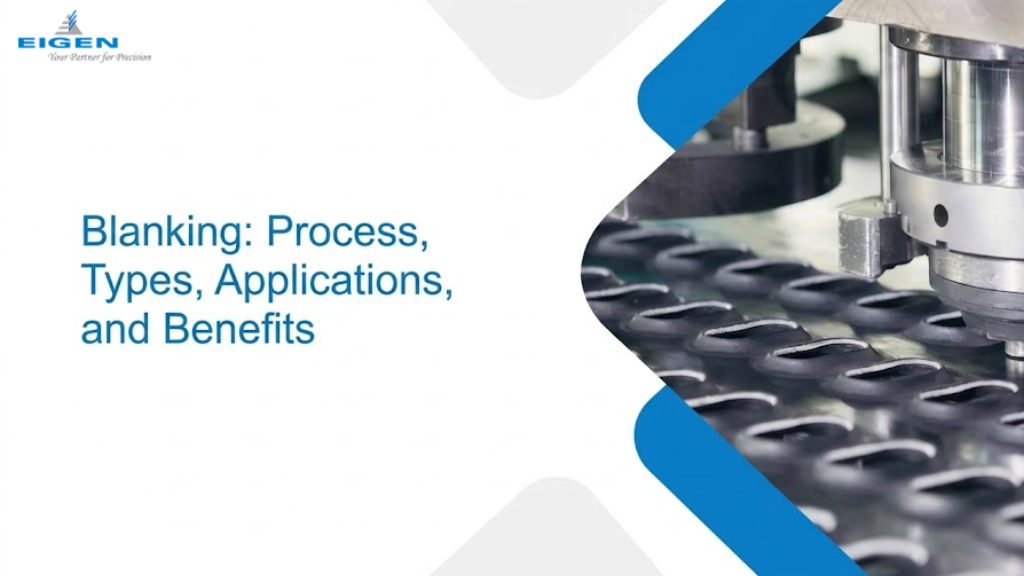
| Key Fact | Blanking in metal manufacturing refers to cutting a flat geometric shape out of either a sheet or coil of metal, where a die is used with a press to cut the shape from the sheet or coil. |
Walk through any modern factory floor, automotive, electronics, aerospace, and somewhere in that production chain, a blanking press is at work. Quietly and at high speed, it cuts flat sheet metal into precise shapes that go on to become gears, connectors, panels, surgical instruments, and hundreds of other components we rely on every day.
Blanking is one of the foundational operations in sheet metal fabrication, yet it is often underestimated. Understanding how it works, when to use which variant, and what it can and cannot do is essential knowledge for any engineer or procurement professional sourcing precision metal parts.
This guide covers exactly that, from the mechanics of the cut to the full range of blanking types, key industries that depend on it, and the real-world advantages it brings to high-volume production.
What Is Blanking?
Blanking is a shearing operation in which a punch forces a flat sheet of material, usually metal, through a matching die to cut out a shape of a predetermined size. The piece that is cut out is called the blank, and it is the desired part (or the starting form for a further operation, such as deep drawing or bending). The surrounding sheet that remains after the blank is removed is the scrap, or skeleton.
This is where blanking differs fundamentally from piercing. In piercing, the removed portion is the waste, and the sheet with its newly created hole is the product. In blanking, it is the reverse: the cutout is the product, and the remainder is scrap.
How did the cut happen?
When the punch descends, it first creates plastic deformation in the sheet, then initiates a crack at the cutting edge. The crack propagates through the sheet thickness until the blank separates. The quality of this cut edge, how smooth it is, how much rollover or burr is present, depends on three primary variables: the punch-to-die clearance, the material type and thickness, and the sharpness of the tooling.
A tighter clearance generally produces a smoother, more vertical shear zone and a smaller burr. A larger clearance leads to more fractures and tears on the edge. For standard blanking, clearance is typically set at 5–10% of the sheet thickness; for fine blanking, this drops to just 0.5–1%.
What are the Types of Blanking?
Blanking is not a single technique. Several variants have evolved to meet different requirements around edge quality, production rate, material thickness, and part complexity.
1. Standard (Conventional) Blanking
The most widely used form. A punch and die set cuts the blank in a single stroke. It handles a broad range of materials and thicknesses and is the natural choice for high-volume production where moderate edge quality is acceptable. Post-processing, such as deburring, may be required for some applications.
2. Fine Blanking
Fine blanking applies pressure from three directions simultaneously: a V-ring (stinger ring) presses into the sheet around the cut perimeter to restrain lateral material flow, the main punch descends from above, and a counter-punch pushes upward from below. The result is a shear zone that is clean and smooth across the full thickness of the material, with no fracture zone, no significant burr, and flatness well within tolerance.
Tolerances of ±0.001 to ±0.05 mm are achievable, and parts often emerge ready to assemble without any finishing. It is the go-to method for automotive gears, clutch plates, high-precision brackets, and aerospace fittings.
3. Progressive Blanking
In progressive die blanking, a strip of sheet metal advances step by step through a series of die stations in a single tool. Each stroke of the press completes one or more operations simultaneously, piercing, notching, forming, and finally blanking, so that a finished part exits the die with every press cycle. This method is highly efficient for complex, small-to-medium parts produced in very large volumes.
4. Compound Blanking
A compound die performs blanking and piercing simultaneously in one press stroke. For parts that need both an outer profile and internal holes, such as washers, this approach eliminates separate operations and improves alignment between the outer edge and any internal features.
5. Laser Blanking
Laser blanking replaces the physical punch-die system with a high-powered laser beam controlled by CNC. It excels for prototyping, short runs, and complex contours that would require expensive hard tooling in conventional blanking. There is no tooling cost, no setup time for die changes, and minimal lead time. Trade-offs include a slower cycle rate and a heat-affected zone at the cut edge.
6. Rotary Blanking
Rotary blanking uses two counter-rotating rolls fitted with cutting dies to shear blanks continuously from a strip of material. It operates at very high speeds and suits simple shapes produced in enormous quantities, such as gaskets and circular blanks.
Standard vs Fine vs Laser Blanking
| Parameter | Standard Blanking | Fine Blanking | Laser Blanking |
| Edge Quality | Moderate | Excellent | Very Good |
| Tolerance | ±0.05–0.1 mm | ±0.001–0.05 mm | ±0.05–0.1 mm |
| Tooling Cost | Medium | High | Low |
| Production Volume | High | High | Low–Medium |
| Post-processing | Often needed | Minimal | Minimal |
Where Is Blanking Used? Industry Applications
Blanking’s combination of speed, accuracy, and material flexibility means it appears in virtually every manufacturing sector that works with sheet metal.
| Industry | Blanked Components | Typical Blanking Type |
| Automotive | Gears, clutch plates, brackets, washers | Fine blanking, progressive blanking |
| Electronics | Connectors, shields, lead frames | Progressive blanking, compound blanking |
| Aerospace | Fittings, brackets, structural panels | Fine blanking, laser blanking |
| Medical Devices | Surgical instruments, implant components | Fine blanking |
| Consumer Goods | Cookware, appliance panels, hardware | Standard blanking, rotary blanking |
In the automotive sector alone, a single vehicle can contain hundreds of fine-blanked components, from synchronizer rings and valve plates to safety belt parts and steering column brackets. The electronics industry depends on progressive blanking to produce millions of connector terminals and lead frames with sub-millimetre features at high speed. In medical device manufacturing, fine blanking produces surgical forceps, scalpel handles, and implant components, for which surface quality and dimensional accuracy are non-negotiable.
Key Benefits of the Blanking Process
High Repeatability at Production Scale
Once a blanking die is set and validated, every subsequent part is a near-perfect copy of the first. The process tolerates very little variation from cycle to cycle, which is why it is the backbone of high-volume industries like automotive and electronics.
Material Efficiency
Blanking layout, how blanks are nested on the strip, directly affects material yield. Good nesting can reduce scrap to under 15% in many cases. Progressive blanking is particularly efficient because the strip advances in a controlled manner, and nesting is optimised in the die design phase.
Minimal Post-processing with Fine Blanking
Standard blanking usually requires deburring after the cut. Fine blanking, by contrast, produces parts with clean shear faces and tight flatness that are frequently ready for assembly straight from the press. This reduces cycle time, floor space, and secondary operation costs substantially.
Cost-effectiveness for Medium and High Volumes
Although hard tooling carries an upfront investment, blanking becomes progressively more economical as volumes increase. At medium-to-high runs, the per-part cost falls well below that of machining, laser cutting, or EDM. Laser blanking offsets tooling cost at the low-volume end of the spectrum.
Automation-Ready
Blanking integrates naturally with coil feeding systems, automatic stackers, and robotic handling. Fully automated blanking lines run around the clock with minimal human intervention, making the process ideal for lights-out manufacturing environments.
Wide Material Compatibility
Blanking works across a large range of metals: low-carbon steel, stainless steel, aluminium alloys, copper, brass, phosphor bronze, galvanised steel, and more. Material selection drives choices around punch-die clearance, press tonnage, and tooling material, but the blanking principle applies broadly.
Blanking vs Punching: A Practical Distinction
These two operations are often confused because they use the same equipment and tooling. The distinction is purely one of intent and outcome.
- In blanking, the cut-out piece is the desired product (the blank). The surrounding sheet is scrap.
- In punching (piercing), the piece removed is the waste. The sheet with the hole is the product.
Both operations often appear in the same progressive die, piercing creates holes first, and blanking separates the final part last. Understanding this sequence helps in die design and process planning.
Choosing the Right Blanking Method
Selecting the most appropriate blanking variant comes down to four primary considerations:
- Edge quality requirements: If smooth, burr-free edges are critical to function or assembly, fine blanking is the right choice. For non-critical edges, standard blanking is more economical.
- Production volume: High volumes favour progressive or compound blanking for efficiency. Low volumes or prototypes suit laser blanking.
- Part complexity: Multi-feature parts with tight inter-feature tolerances call for progressive or compound dies. Simple flat profiles are handled well by standard blanking.
- Material and thickness: Fine blanking handles materials up to 13–16 mm thick with high strength. Laser blanking is more flexible for exotic alloys and unusual thicknesses.
Conclusion
Blanking has been shaping the modern manufacturing world for over a century, and its relevance has only grown as industry demands tighter tolerances, faster production rates, and greater consistency. Whether you are producing washers by the million on a progressive die or crafting precision aerospace brackets through fine blanking, this process offers a combination of repeatability, efficiency, and material versatility that few alternatives can match.
At Eigen Engineering, we work with manufacturers across industries to identify the right blanking strategy for their specific requirements, from die design and material selection through to process validation and production optimisation. If you are evaluating a new component design or looking to improve an existing blanking process, our team is ready to help.
Frequently Asked Questions
What is the difference between blanking and stamping?
Stamping is the broad category of sheet metal press operations, it includes blanking, punching, bending, coining, embossing, and deep drawing. Blanking is one specific operation within stamping, focused on cutting a flat shape from sheet material.
What materials can be blanked?
Most metals that can be formed cold are suitable for blanking: carbon steel, stainless steel, aluminium alloys, copper, brass, bronze, and galvanised or coated steels. Material hardness, thickness, and ductility influence the blanking parameters and tooling design.
What is die clearance, and why does it matter?
Die clearance is the gap between the punch and die edges. It directly controls edge quality: too little clearance causes excessive tool wear; too much causes a rough, torn edge with a large burr. Standard blanking uses 5–10% of sheet thickness; fine blanking uses 0.5–1%.
Can blanking be combined with other forming operations?
Yes, progressive dies routinely combine blanking with piercing, bending, forming, and coining in a single tool. Blanking is also frequently the first step before deep drawing or stamping operations on the resulting blank.
About Author
Related Posts