
What is a Rigid Copper Busbar? Applications and Advantages
- Busbars |
- Jul 15, 2026
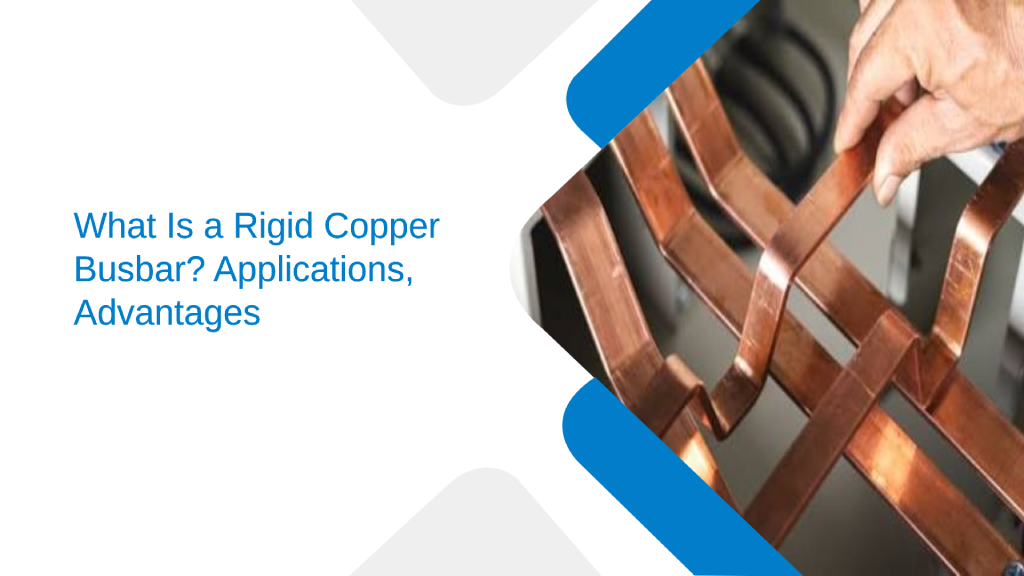
With growing mechanisation, electrical appliances and technology, the need to meet efficiency holds priority. A rigid copper busbar is a solid conductor, which is produced from high-conductivity copper, and helps to allocate electricity within switchboards, panel boards, data centres and industrial plants. Imposing rigidity, it maintains a fixed shape and generates a sturdy flow for electricity. Because copper is valuable and a highly conductive metal with strong mechanical properties, these bars are durable and reliable for everyday use.
What are Rigid Copper Busbars?
A rigid copper busbar is generally fabricated as a flat strip or can come in a rectangular-shaped bar. It can be insulated at the time of application. Acting as a stimulus to high end connectivity for many circuits and enabling electricity to be distributed correctly, it is quite useful.
Simple Operation
Unlike flexible bars, the conductor is rigid and can be mounted safely on insulators and support structures. This helps to create solid connectivity for electricity generation inside switchboards and distribution panels. The mechanism is simple to understand as the current flows through the bar from the transformer or generator and is then allocated to other loads. The large cross-sectional area of the copper reduces electrical resistance and reduces voltage drop with sufficient energy supply.
Application Procedure
Having a strong and sustainable front across diversified electrical areas, a rigid copper busbar ensures adequate power distribution. They serve as the backbone to a low voltage switchboard or panels by connecting incoming breakers, bus couplers, and outgoing circuits. Creating an outlet for current to flow freely, they can be useful on a smaller scale than with large cable bundles.
Having a solidifying role in power substations, these bars interconnect transformers, circuit breakers,and switch gears. Substation bars are organised in a manner where they provide more reliance and elasticity while a fault appears in a line.
Usability of Rigid Copper Busbars:
While championing responsible production and acting as an electrical generator for industrial appliances, these copper bars seem to be quite in demand. With their diversified usability in industrial sectors, steel mills, paper mills and high-current distribution for motors, furnaces, and other equipment a busbar continues to predominate the modern market. These bars ensure thermal efficiency and help minimize heat build up.
Data centres and commercial buildings use busbar trunking and rigid busbar systems for useful power distribution to server rooms, UPS stations and heavy duty loads. As compared to complex cable systems these bars can ease the maintenance and improve electrical flow within rooms. Serving benefits for renewable energy sources, solar energy and wind energy benefit from strong conductivity and low maintenance of busbars. They can be used to connect power banks, switch gears and distribution panels.
Good conductor of heat:
The foremost merit of a rigid copper busbar is its excellent power conductivity. Copper and its alloys are known for being the best conductors of heat and serving electrical power among distribution cables. They help to provide lower resistance and are budget friendly with less voltage loss. The overall energy efficiency improves with bringing down the operational costs and ensuring more reliance.
Another vital advantage is excellent thermal effciency. Copper conducts heat in a very productive manner permitting heat produced by electrical current to dissipate more strongly. Better heat dissipation can assist in bringing down temperatures and improve equipment reliability.
Stable electrical generators:
With a durable and effective current holding capacity, a compact copper busbar can carry the required amount of current without a sharp increase in temperature. This allows engineers to create compact switchgear and distribution systems while meeting current rating requirements. Since mechanical stability matters, rigid bars have more tolerance than flexible bars.
Easy installation and low maintenance are added benefits of using these copper busbars. With practical connectivity, spiked with correct inspection, equal testing and tightening, these bars have a simple and convenient mechanism. Structured patterns can help to create longevity and reduce risk. Copper is a highly sustainable metal which, when protected from depleted environments, can ensure best results.
Strong Grip and Spaciousness:
Space is key, and busbar systems often provide current-carrying capacity and space savings. This is manageable in modern buildings, data centres, and industrial facilities where electrical room space is limited. Unlike traditional cable systems, these bars offer low voltage, more potential to hold heat, flexibility and stable installation. Cables can also prove advantageous in small areas, but busbar is truly convenient for a massive technical set up or wider distribution.
Design and Maintenance:
Choosing a rigid copper busbar involves correct introspection, current analysis, area and density of voltage, permissible temperature, environmental conditions, and available installation space. Busbar sizing must abide by applicable standards and manufacturing requirements. Designers also choose clearances and thermal expansions. With low maintenance and cost-effectiveness, busbar helps to connect intricate panels and offers wide distribution.
Typical maintenance activities include checking bolted joints for proper torque, inspecting for excessive heat or damage, and cleaning dust or any contamination in nearby areas.
Conclusion
A rigid copper busbar is an essential feature of modern electrical powerhouses. Their high electrical conductivity, superior thermal effectiveness, stable short-circuit holding capacity, compact design, durability, and low maintenance make them the perfect choice for industrial setups. As electrical networks continue to demand higher efficiency, more reliability and value driven concepts, busbars truly elevate stable electricity generation with their power driven magnetism. Choosing a properly designed copper busbar system can improve energy efficiency, enhance operational safety, reduce complexity and lower voltage. It is therefore important to use these bars for larger area and better productivity.
About Author
Related Posts